
2019.09.18
Press release regarding the lifespan of household appliances
18.9.2019
APPLiA believes that Sveriges Radio in its program series on documented lifespans of household appliances addresses an important environmental aspect that is central to highlight for several reasons. The German study referred to, for example, shows that 30% of the products that are discarded are in working condition. Over time, we have seen changes in consumer behavior where an increasing proportion of still functioning products are recycled. APPLiA, together with El-Kretsen, wants to provide additional information regarding lifespans for the Swedish market.
APPLIANCE
APPLiA is a trade association for manufacturers of small and large household appliances in Sweden. The industry has worked on sustainability issues for a long time and is one of the industries that has come the furthest. Among other things, we have members who have declared that they are now working to reduce the company's climate impact in such a way that the company's production will be completely climate-neutral by 2030. APPLiA is one of 20 trade associations that together formed El-Kretsen in 2001 when producer responsibility for end-of-life electronics was introduced.
Clear trends in the market are that the technical lifespan of products is increasing in general, but that consumers are replacing their products earlier and earlier, even if they still work. "Over the past 10 years, we have seen more and more flawless products coming in for recycling, for example when people renovate their kitchens at home or make so-called series replacements in larger apartment buildings," says Kent Oderud, chairman of APPLiA.
Thanks to technological developments, we can now, for example, track the number of cycles a coffee machine, dishwasher and washing machine goes through when it is serviced or recycled. Here we see that the products are used significantly more intensively today. On average, products are used up to 50 % more today than 20 years ago, for example, the dishwasher and washing machine in a household are often used several times a day today.
The Electric Circuit
El-kretsen is a service company with the mission of solving producer responsibility for its affiliated producers. Since 2001, El-Kretsen has organized a nationwide collection system for used electronics and batteries in collaboration with all municipalities in the country.
Read more about El-Kretsen and the results of the recycling in the sustainability report
Amounts collected
In 2018, over 145,000 tonnes of electronic waste were collected and recycled in Swedish facilities specializing in electronics recycling. The amount of electronic waste submitted for recycling is becoming smaller and lighter, and since 2011 there has been a clear trend that the total weight of collected electronics is decreasing while the number of products is slowly increasing. In general, it can be said that the collection of electronic waste follows technological developments, but with a delay of about ten years.
Life
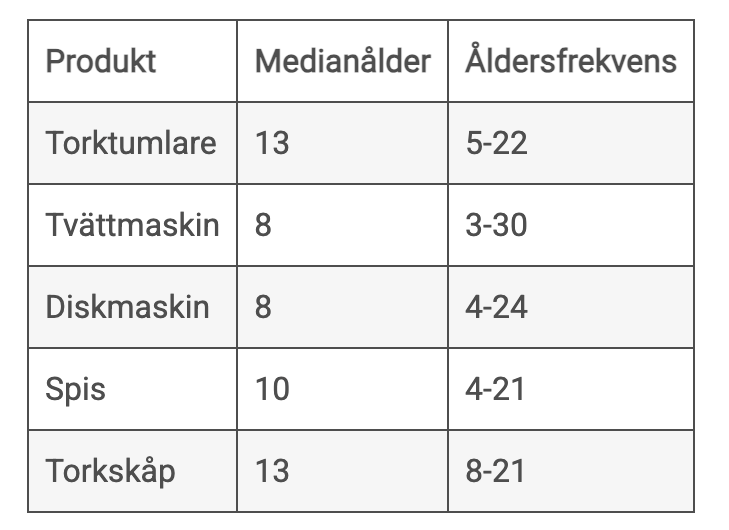
El-Kretsen conducts ongoing studies of the age of the collected products. This is done at El-Kretsen's analysis facility in Arboga, where a statistically significant sample of all small and medium-sized products submitted for recycling are passed through and analyzed, as well as during random analyses at the country's recycling centers. In 2018, El-Kretsen conducted a study on collected electrical waste in the form of small and medium-sized household appliances, the median age of the products within the group as a whole is 11 years.
For larger appliances, the median age varies for different types of products and brands, the median age for this entire group is 9 years. For example, for refrigerators, there are still around 40 % of the products that come in for recycling that contain freon and stopped being sold in 1993, says Martin Seeger, CEO of El-Kretsen.
Functionality
In 2019, El-Kretsen initiated a project in Skåne to see whether and how much of the white goods that are handed in to municipal recycling centers can be recycled. For large household appliances, it is the use phase that dominates the environmental impact, and therefore it may be environmentally justified to replace energy-consuming products, which is the case, for example, with the remaining 40% CFC products. It is therefore important to distinguish between newer, more efficient and functional products on the one hand, and older, energy-intensive or broken products on the other. Extending the life of white goods through recycling can in some cases be environmentally justified. However, a prerequisite for the project is that the goods must have commercial value and be energy efficient.
The proportion of what is submitted that is functional and has a market on the secondary market is estimated to be between 5 and 10 percent. The proportion varies greatly depending on the collection site (16 percent at the highest, 2 to 4 percent at the lowest). Significantly more products are functional but completely lack demand on the secondary market.
Media contact
APPLIANCE
Name: Kent Oderud, chairman of APPLiA
email: kent.oderud@applia-sverige.se
Mobile: +46 70 4201589