
2025.09.02
The electronics tax shows why Sweden is losing competitiveness
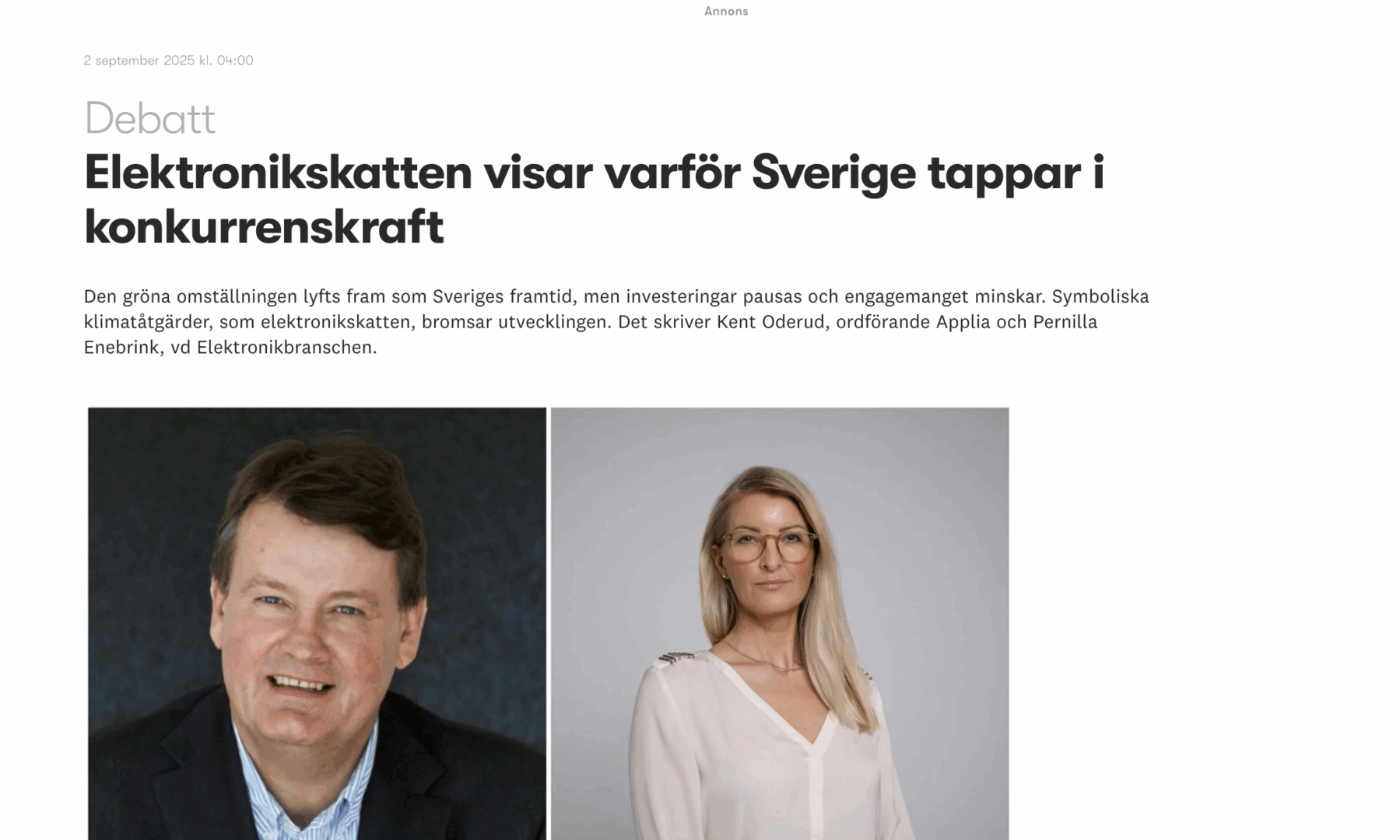
Debate: Applia and the Electronics Industry in the Althing. The green transition is highlighted as Sweden's future, but investments are paused and commitment is decreasing. Symbolic climate measures, such as the electronics tax, are slowing down development. This is written by Kent Oderud, Chairman of Applia and Pernilla Enebrink, CEO of the Electronics Industry.
In practice, many of the reforms that have been launched have been characterized by a combination of high ambitions and ill-considered symbolic politics. The result has in many cases been taxes and regulations that, while signaling action, neither lead to the desired results nor strengthen Swedish competitiveness. The electronics tax is an excellent illustration of the systemic flaws that are slowing down Swedish transition and growth policy.
Expensive with limited environmental impact
The tax was introduced in 2017 with the aim of reducing the presence of dangerous flame retardants in electronic products. The tax is high; in the most expensive cases it amounts to SEK 685 per product. However, in practice, the environmental control effect has proven to be very limited because the products are produced for an international market that does not take into account Swedish special regulations. The authorities' own evaluations show that the tax has primarily become a source of revenue for the state rather than a tool for reducing harmful substances or environmental toxins.
In addition to not delivering on its original environmental goal, it has also created significant negative effects for both consumers and businesses.
Inhibits innovation and increases costs
By making new electronics more expensive, it slows down investments in more modern, energy-efficient products – products that in many cases would lead to reduced energy consumption and lower climate impact.
For consumers, the tax means an increase in the cost of essential technology such as refrigerators, washing machines, mobile phones and computers. For Swedish companies, it means increased costs, administrative burden and reduced competitiveness in an already highly competitive market. For Sweden, it means fewer jobs and reduced growth.
Distorts competition and favors low-cost imports
But the problem doesn't stop there. The electronics tax also illustrates how Swedish environmental policy helps to distort competition in favor of players outside the country's borders. Thanks to a loophole in the legislation, online retail giants like Temu and Shein don't have to pay the electronics tax, as they sell their goods directly to Swedish consumers without warehousing in Sweden.
The result is that Chinese low-price platforms can offer significantly lower prices than Swedish stores, while at the same time these platforms often sell products with significantly worse sustainability and working conditions than the Swedish and European industry.
This is where the real systemic flaws in Swedish environmental policy become clear: we tax serious actors who invest in higher product quality, better working conditions and lower emissions – while we favor low-cost imports from countries whose production many politicians in other contexts say they want to counteract. When the same politicians at the same time want to talk about strengthening Swedish competitiveness and reducing dependence on China, the political logic becomes contradictory, to say the least.
Scrap the electronics tax
The electronics tax is therefore not just an ineffective environmental tax. It is a concentrate of everything that fundamentally risks undermining Sweden's competitiveness: symbolic politics instead of effective governance, distorted competition in favor of low-cost platforms outside the EU, and increased costs for both consumers and companies without the environmental benefits being realized.
Sweden faces major challenges in restoring credibility in both climate and growth policies. In order to deliver on the green transition, politics must return to using instruments that actually deliver results – not just generate press releases. This is optimally done through common EU regulations. Abolishing the electronics tax would be a simple but symbolically important first step to show that politics is serious.
Sweden needs a climate and growth policy that not only signals ambition, but delivers concrete results. Abolishing the electronics tax would be a first step to restoring both the credibility of the transition and Sweden's competitiveness.