
2022.02.16
Referral review – over-indexation of the electronics tax
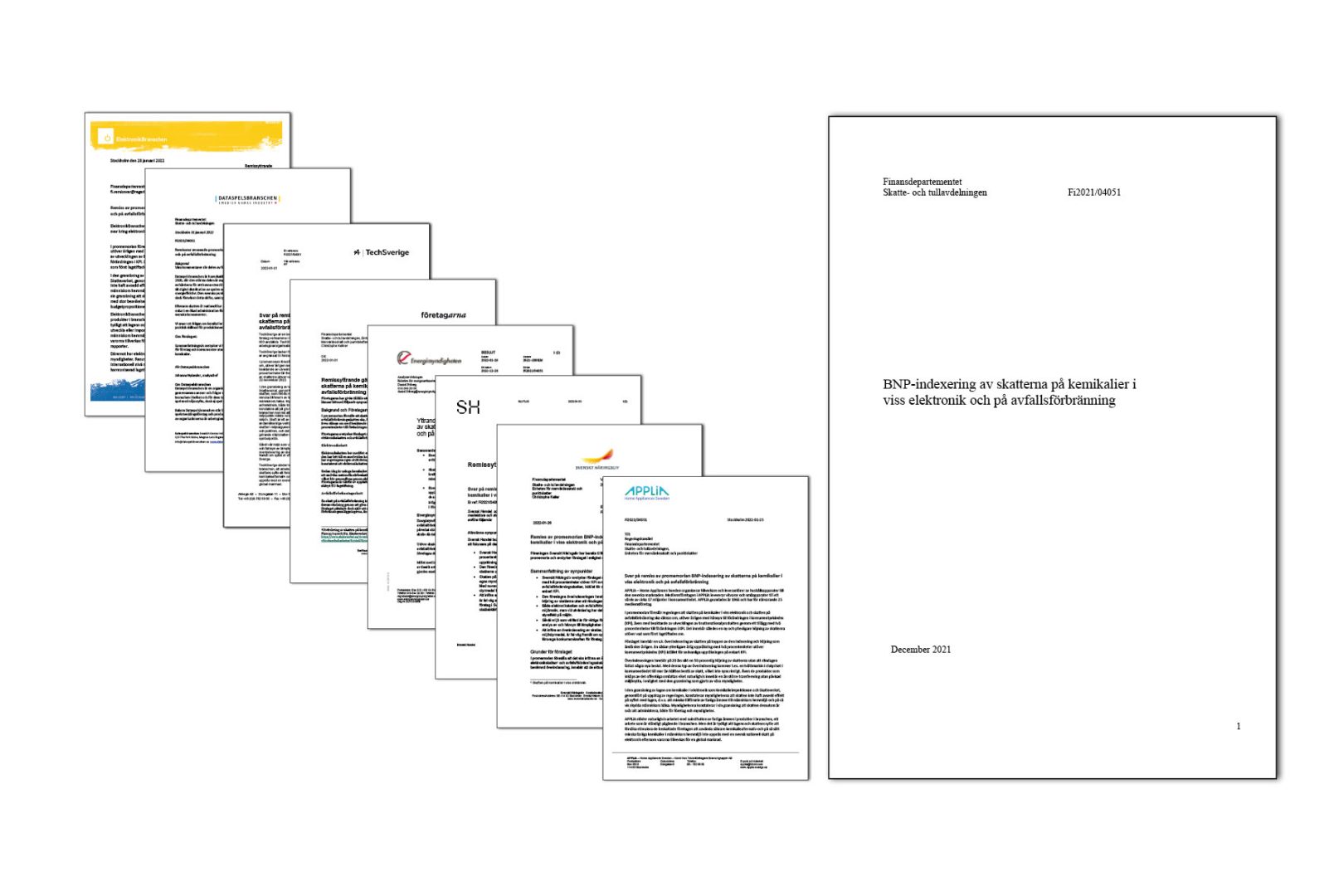
As previously reported, the debated electronics tax has been out for consultation. Here we compile all the consultation responses received.
Earlier this year (newsletter #5/2022, read more here) APPLiAnytt reported on the response of the industry organization APPLiA to the consultation proposal from the government regarding over-indexation of the electronics tax. This proposal involves an annual increase in the electronics tax by 2 percentage points on top of the second, already valid, increase against the CPI at the turn of each year. APPLiAnytt can now report on all consultation responses that have been received by the government from the invited consultation bodies, and it is not cheerful reading for the government.
No referral body gives a complete green light!
None of the invited consultation bodies expresses a consistently positive attitude towards the proposal to introduce an annual over-indexation of the electronics tax in addition to the CPI adjustment that is made annually. Not a single one consultation body! The two that still give the green light for the proposal still have criticism of the design of the proposal for over-indexing. Then there are some authorities that respond to the consultation, but completely refrain from taking a position on the substantive issue, e.g. Swedish Customs, Swedish Environmental Protection Agency and Sweden's Municipalities and Regions.
Shame list for those who don't even respond
Several invited consultation bodies are also on our special 'shame list' because they did not even respond to the consultation request regarding the electronics tax (and/or the incineration tax) proposal for over-indexing! Two of these are Chemicals Inspectorate and College of Commerce. This is surprising since it is precisely government agencies that are obliged to respond to the consultation. For other consultation bodies, which are not authorities, the consultation constitutes an invitation to submit comments on the consultation document.
But also some of these independent referral bodies such as Innovation and Chemical Industries (IKEM), Swedish Environmental Institute, Swedish Electronics and Technology companies seems to have missed the opportunity to express their opinions on the over-indexation. APPLiA really thinks it is a shame when invited consultation bodies do not take advantage of the opportunity to announce their position on the issue and thereby participate in influencing the issue politically! Especially in an election year like this.
 A total of 14 consultation bodies say "NO" and give a red light

In addition to APPLiA, the following consultation bodies oppose the over-indexation (and many of them also express their opinion that the electronics tax should instead be abolished and replaced by increased intensity in the work within the EU to substitute the relevant flame retardants):
Computer games industry (industry organization):
Opposes the proposal in its entirety as it practically means an increase in costs for companies and consumers without improving the environment or reducing the presence of harmful chemicals.
The Finnish Financial Management Agency (authority):
Financial Management Agency makes the assessment that the effectiveness of other policy instruments should be examined before a tax increase in this area is proposed.
Electronics industry (industry organization):
Opposes over-indexing and otherwise believes Electronics industry that since the purpose of the electronics tax is not being achieved, it should be removed.
Energy Companies Sweden (industry organization):
Energy companies Sweden rejects the proposal for GDP indexation of taxes on waste incineration and chemicals in certain electronics.
The Swedish Energy Agency:
The Energy Agency mainly comments on the over-indexation of the waste incineration tax but also notes in general that the reason given for the up-indexation, namely that the tax will steer more effectively towards national climate goals, is not consistent with the conclusion previously drawn regarding the tax's effectiveness.
The Entrepreneurs' Association (business organization):
The entrepreneurs is of the opinion that the electronics tax should be abolished altogether in favor of stricter EU legislation.
The Finnish Institute of Economic Research, Ki (authority):
Ki finds it remarkable that the proposal to supplement the CPI recalculation with a GDP indexation aims to strengthen the demand effect of the chemicals tax, especially when its own impact assessment finds that such an effect is largely absent. It can be added that KI In previous consultation responses, it has been emphasized that the current design of the chemicals tax to reduce the environmental and health effects of flame retardants is a blunt and socio-economically ineffective policy instrument.
Business Regulatory Committee (business organization):
The lack of environmental impact of previous tax increases shows that the current proposal to introduce over-indexation of taxes (as GDP indexation implies), which does not fulfill its function as an environmental policy instrument, is the wrong way forward if the aim is to improve the environment and human health and not weaken the competitiveness of companies in Sweden.
Forest Industries (trade organization):
Provides views primarily regarding the tax on waste incineration, but generally believes that the proposal for over-indexation should be rejected.
The catering suppliers (industry organization):
The proposal to index taxes on chemicals in certain electronics to GDP is rejected. Continuing to ”screw up” the tax rate to a law that should be repealed in its entirety, as the government is now proposing, is completely the wrong way to go if the intention is to achieve real health and environmental improvements.
Swedish Commerce (employers' organization):
Swedish Trade rejects the proposal to introduce an annual over-indexation, with two percentage points above the CPI regarding the tax on electronics instead of the usual increase based on the CPI alone. Swedish Trade is of the opinion that the tax on electronics should never have been introduced and that it should be abolished.
Confederation of Swedish Enterprise (business organization):
Confederation of Swedish Enterprise remains of the opinion that the electronics tax should never have been introduced and that it should be abolished. Previous increases in the tax have not made the tax more effective. For example, an increase of more than 30 percent was implemented in August 2019. The lack of environmental impact of previous increases in the tax shows that the current proposal for an annual over-indexation is the wrong way forward if the aim is to make the tax more effective in relation to the purpose of the law.
TechSverige (industry organization):
Tech Sweden believes that since the purpose of the law on tax on electronics is not being achieved, it should be abolished and rejects the proposal for over-indexation and otherwise refers to the industry-wide position previously published by APPLiA, Electronics Industry, Confederation of Swedish Enterprise, Swedish Trade, Technology Companies and Tech Sweden.
Other consultation responses:
In addition to the officially invited consultation bodies, Technical Works in Linköping, Renovate and Waterfall have spoken out against the proposal to over-index the combustion and/or electronics tax. So too have the white goods and household appliance companies Gram A/S Sweden, Severin Swedish AB and Bertazzoni Scandinavia AB.
 7 referral bodies have "no opinion"”

Energigas Sweden (industry organization):
Energy gas chooses to refrain from speaking out this time.
Swedish Environmental Protection Agency (authority):
Swedish Environmental Protection Agency has no comments on the submitted proposals for amendments to the Act (2016:1067) on taxes on chemicals in certain electronics.
Energy Market Inspectorate (authority):
Energy Market Inspectorate (Ei) has no views on the proposal for GDP indexation of taxes on chemicals. No However, it rejects the proposal for GDP indexation of the tax on waste incineration.
Swedish Municipalities and Regions (employers' organization):
Announces that the association refrains from providing comments.
The Swedish Agency for Economic and Regional Growth (authority):
The Agency for Economic Growth has no views on the matter.
Swedish Customs (authority):
Customs assesses that the memorandum does not contain anything that significantly affects the authority and has no objections to the proposal.
Vinnova – the state innovation agency:
Vinnova has no comments on the classified referral.
 The two positives still have critical views

The Regulatory Council (authority):
Regulatory Council is a special decision-making body within the Swedish Agency for Economic and Regional Growth whose members are appointed by the government. They give the green light to the proposal in principle but note that the impact assessment certainly contains shortcomings regarding the reporting of compliance with EU law, the description of the size of the companies concerned and the competitive conditions between companies. In an overall assessment, they believe Regulatory Council nevertheless, the shortcomings are not of decisive importance.
The Swedish Tax Agency (authority):
The Swedish Tax Agency has no objections to the introduction of the proposal, but has critical views on how the calculation basis for the over-indexation has been designed.
If you would like to read the respective consultation responses from all of the above consultation bodies in full, these are available. here.
The story goes on… further suggestions published
At the time of writing, another memorandum on changes to the electronics tax has been published by Ministry of Finance for another round of consultation. It has the designation Fi2022/00478, with the exciting (!) title ”A simpler and clearer chemicals tax”". And we can thus conclude that no other tax in Sweden has been the subject of so many proposed amendments and updates shortly after its introduction – a clear sign that the introduction of the electronics tax in 2017 took place without proper basis and without the proper preparations. Now it remains to be seen whether this new proposal can in reality provide a "simpler and clearer tax". Continue to follow the continuation and reactions to this new proposal here in APPLiAnytt – TO BE CONTINUED, as they say in the soap opera world!
Kent Oderud, Chairman of APPLiA