
2022.02.09
Fat Tuesday is almost here – why do we celebrate?
Fat Tuesday is approaching, a great opportunity to make some dough. Why not let the kitchen machines and electric mixers take center stage and the icing sugar drop? Here you will find out everything about what it is we are actually celebrating and how to avoid dying of the bread death, or was it a stroke that took King Adolf Fredrik's life?
Fat Tuesday is the last day before Easter Lent, and is celebrated on the Tuesday after Shrove Sunday, which is the day that begins Lent – a Christian holiday the three days preceding Lent, which also includes Blue Monday, which then continues until Easter. Fat Tuesday falls between February 3 and March 9 – this year March 1 – and is a combination of the two words fat and Tuesday, where fat refers to all the fatty foods that were traditionally eaten on the last day before Lent.
Shrove Tuesday is also called White Tuesday, which possibly comes from the white wheat flour used to bake Shrove Tuesday buns – also called fastlags buns or semla – with. Incidentally, the word semla probably comes from the Latin simila, which means fine flour.
Originally, semlan was a plain, unseasoned wheat bun without cream or almond paste, and the first time semlan is mentioned in a Christian context is in Gustav Vasa's Bible in 1541. One theory as to why people started filling semlan with things like almonds, cream and butter was that during Lent, people were only allowed to eat bread. Another is that it is simply delicious.
”Heisse Wecke” is a South German term for wedge-shaped wheat bread, which comes from the fact that the German buns were often shaped like wedges to fit well in the bottom of a saucepan, where they were cooked in milk. This is probably where the name hetvägg comes from – a dish that was relatively common in well-to-do homes in the 18th century. The wedge shape still lives on today, but only when it comes to the lids – but the buns are no longer cooked in a saucepan but are served in hot milk instead, if it is the hetvägg variant that is served.
The Nordic semla
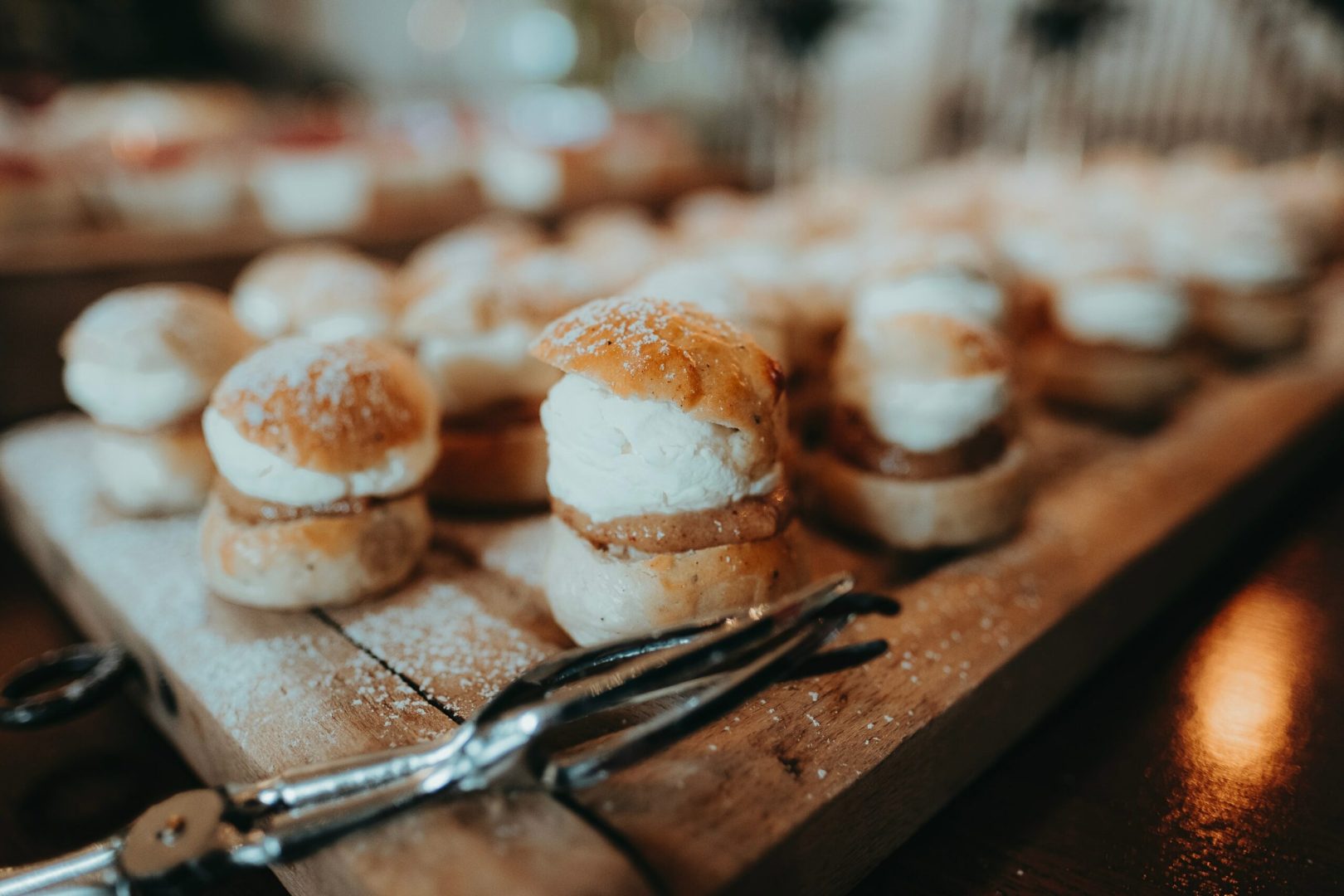
The most common way to eat semlar in Sweden today is with whipped cream under the bun lid, powdered sugar on the lid, and with almond paste (not infrequently mixed with cream and hollowed out bun) in the semlar. In Denmark and Norway, the semlar have jam (and sometimes also vanilla cream) instead of almond paste, and in Finland there are both varieties.
In England, Shrove Tuesday is called ”Shrove Tuesday” or ”Pancake Day” and people eat pancakes. In Germany, it is called ”Faschingsdienstag” and the day is celebrated with carnival. In France, it is called ”Mardi gras” (which means Fat Tuesday) and that is where one of the most famous carnivals in the world – Mardi Gras in New Orleans, USA, which takes place between Epiphany and Shrove Tuesday – gets its name.
The murderous wall of heat
On Nordic Museum.se You can read a lot about semla, for example about its role in a regicide:
”Sometimes it is claimed that the Swedish King Adolf Fredrik died of too many hot cakes on Shrove Tuesday, February 12, 1771. In reality, he died of a stroke, a name for both stroke and heart attack, after a meal that was enormous in our eyes. The meal consisted of oysters, lobster, sauerkraut and hot cakes. The king's death aroused strong feelings against hot cakes, and the poet Johan Gabriel Oxenstierna argued that Shrove Tuesday should be banned and 'hot cakes should be exiled from Sweden, since they committed regicide'.’
Ola Larsson
Photo: Jonas Jacobsson/Unsplash