
2022.06.01
Extend shelf life & reduce food waste
The Swedish National Food Administration is working, among other things, to try to reduce food waste and in a new report highlights the importance of setting the temperature in the refrigerator at four degrees. One way to reduce food waste is to extend the shelf life, and then a refrigerator with a so-called "Zero Zone Drawer" is a very wise investment.
As part of the Swedish National Food Agency's ongoing government mission to reduce food waste, together with the Swedish Board of Agriculture and the Swedish Environmental Protection Agency, the Swedish National Food Agency has commissioned the research institute RISE to investigate whether the taste of milk and oat drink in opened packages changes once the best-before date has passed and how many days it takes before the taste is noticeable.
”"Food waste must be reduced and the goal of this survey is to make consumers aware that milk and oat drinks last much longer than people think. Many people probably pour out the drink when the best before date has passed without actually knowing that it is still safe to drink," says Karin Fritz, food waste expert at the Swedish National Food Agency.
The results of the study show that there is no difference in taste 14 days after the best-before date for an opened package of milk, when stored at four degrees Celsius. For oat drink, no difference is noticeable even after 16 days, when compared to a newly opened package. The products were not tested over a longer period in this study.
”"By keeping the refrigerator cold, four degrees Celsius, you extend the shelf life of the food. This gives you more time to eat it," says Karin Fritz.
Swedish National Food Agency – Facts about food waste
* One third of all food produced in the world is not eaten.
* Food waste is food that is produced with the intention of becoming food, but which for various reasons is not eaten or drunk. Food waste occurs throughout the food chain and the majority of food waste occurs in households.
* Food waste accounts for between 8-10 percent of all greenhouse gas emissions in the world.
* If food waste were a country, it would be the third largest emitter of greenhouse gases in the world, after China and the United States.
* Reducing food waste in the world is an important contribution to the climate, which is why the UN's goal in Agenda 2030 is to halve global food waste, and reduce waste and losses throughout the food chain.
* If there was no food waste in the world, three billion more people would be fed and not hungry.
* Every year, households in Sweden throw away approximately 19 kilograms of edible food per person. The most common food waste is fruit, vegetables, bread and leftovers.
* In addition, 18 kilos of food and drinks are thrown away down the sink per person per year. The products most often thrown away are coffee, tea and dairy products.
* A total of 37 kilograms of food is thrown away per person per year, for a family of two adults and two children it is 148 kilograms per year.
* A food waste of 19 kilograms in the trash could correspond to over 40 meals per year for one person (a lunch usually weighs about 400-500 grams).
* 18 kilos of food waste poured down the sink could be equivalent to 90 cups of coffee (calculating that a coffee cup is 2 deciliters = 200 g).
* For a family of two adults and two children, food waste corresponds to a cost of between 3,000-6,000 SEK per year.
Food waste – An emissions problem
”If food waste were a country, it would be No. 3 – after the US and China – in terms of carbon emissions, with food waste accounting for 8 percent globally. It is the single largest solvable emissions problem today,” said Dr. Aidan Mouat, at the Tackling Food Waste With Technology conference session at CES 2022.
Dr. Aidan Mouat, Hazel Technologies Inc, sells products to prevent food waste, in the form of active packaging materials that after a certain time can release ingredients in the form of steam into the storage atmosphere of food products, thus tripling the shelf life without having to add chemicals to the food and without having to change the packaging.
”Zero Zone” – A way to reduce food waste
A large part of the food we buy is not eaten, but instead ends up in the trash. There are certainly different opinions about exactly how much is thrown away, but according to National Geographic's article "Share of food loss and waste worldwide in 2015," 45 percent of fruit and vegetables go to waste.
More current figures were published on elon.se on February 19, 2020, and there you can read in the article ”Reduce food waste” that one million tons of food are thrown away in Sweden every year – this corresponds to approximately 25 kilograms of fully edible food per person per year, and means that every fifth bag of food brought home from the store ends up in the trash. Food waste is approximately 100 kilograms per person per year, but three quarters of what is thrown away is not ”fully edible”.
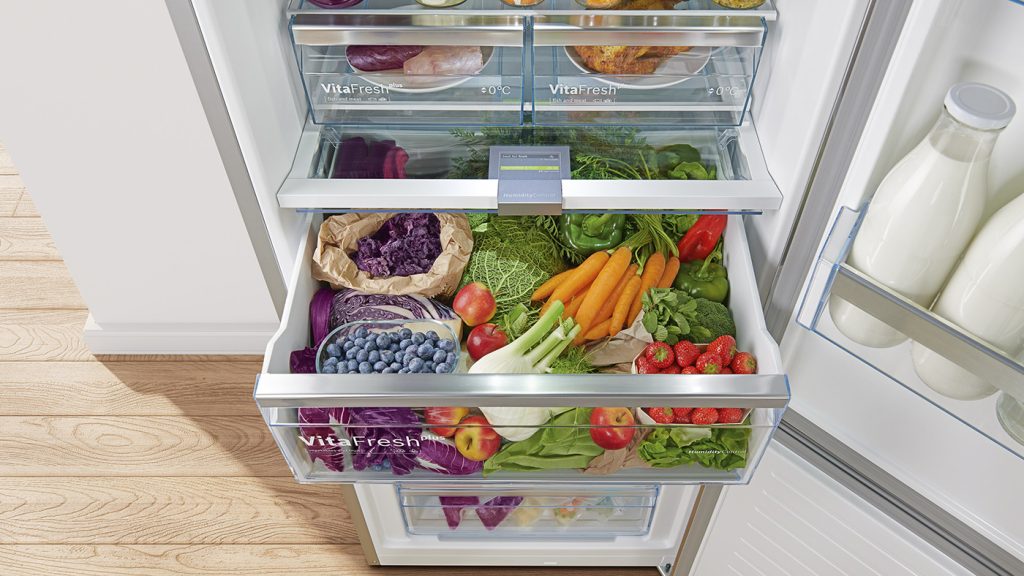
One way to reduce food waste is to purchase a refrigerator that is equipped with one or more special drawers where the temperature is just above zero degrees. This type of drawer, which has been on the market for many years but has recently received increasing attention, is called a number of different things depending on the manufacturer and functionality, such as Zero Zone Drawer, Activ0, Cool Space Plus, CrispZone, Dynamic 0, FreshZone, hyperFresh, Life plus zone, NaturaFresh, PerfectFresh, SuperFresh, VitaFresh, VitaminCare zone, Zerobox and ZeroZone.
Bosch – Questions and Answers
Given the general interest in minimizing food waste, APPLiAnytt 2020 asked a number of questions to one of the pioneers of ”Zero Zone Drawers”, Bosch, whose name is VitaFresh. Below are the questions and answers from 2020, as they are just as relevant now as then.
What benefits does ”zero zone” provide for users?
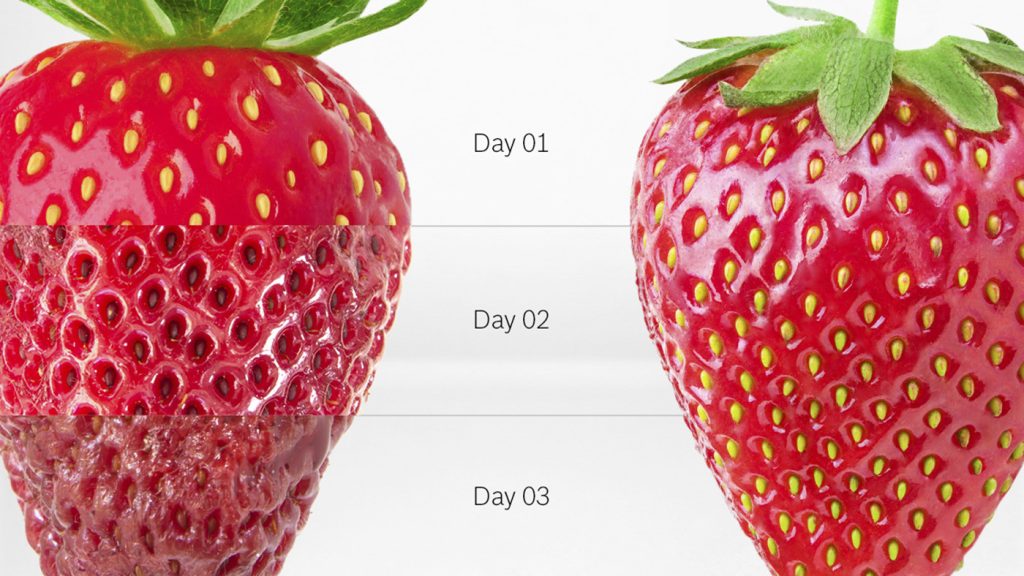
“Food stays fresh longer, up to three times longer than in a traditional refrigerator, thanks to the combination of the correct temperature and humidity. Because you can store fruit and vegetables for longer, for example, you don't have to go shopping as often, and in the long run you also save money because you don't have to throw away as much food,” says Antonio Lamera, Product Manager Cooling BSH Home Appliances.
What is the knowledge about food storage in the "zero zone" among store staff?
– We continuously conduct training for store staff, so the knowledge in the store should be very good, says Antonio Lamera.
The technology has been around for many decades – why does it seem to only be catching on now?
– It is true that the technology has been around for a long time, but almost exclusively as a premium feature. As people in general are more aware of things like the environment and food waste today, this has become more interesting for consumers, explains Antonio Lamera.
– It is also the case that the vast majority of people replace their appliances when the old ones break, which means that only then, as potential buyers, do they discover that sustainability zones exist on the market, explains Maria Ölander, Brand Manager Bosch Home Appliances, BSH.
How is it technically guaranteed that there will be no freezing temperatures in this zone?
– This is ensured through the use of sensors and continuous calibration, which ensures that it is never below zero degrees, but close to zero. Sensors measure both the ambient temperature and the temperature inside the refrigerator, to maintain a constant internal temperature with as few fluctuations as possible. In this way, we can maintain freshness for a longer period of time. The function that ensures a constant temperature in the refrigerator is called FreshSense, explains Antonio Lamera.
What is the price difference for refrigerators with a ”zero zone” compared to those without?
– We offer VitaFresh in different variants, but generally you can say that they are approximately 10-20 percent higher in price, explains Antonio Lamera.
What is the significance for the market?
– We don't have statistics from GfK, for example, but we have sold well in recent years. However, the technology is still a premium feature. We expect it to increase due to awareness of sustainability and food waste, and also due to the current world situation, says Antonio Lamera.
Will all refrigerators have a ”zero zone” in five years?
– It depends on where the market is going. We are happy with the sales of premium products with this technology that we have, and in the future the technology will likely end up in more products if the market continues according to the current trend, concludes Antonio Lamera.
Maria Ölander believes that it is unnecessary to throw away as much food as we do today, when the technology exists to avoid having to do so – vegetables, fruit and mushrooms are examples of foods that can be stored much longer at the correct humidity and temperature.
– ”Zero Zone” is also good for fish and meat, as the aging of the food is slowed down – but then it is important that the air is dry instead of humid, concludes Maria Ölander.
More information about Bosch VitaFresh, VitaFresh Plus and VitaFresh Pro can be found at here, and if you want to see a table showing which types of food really benefit from proper storage in the refrigerator, you can click here (an example is broccoli which should last 46 days in a VitaFresh Pro box compared to 5 days in a conventional vegetable box at 4 degrees).
Ola Larsson