
2026.04.01
Winning in a volatile market, with technological developments and changing consumer behaviors, requires more than cost control
About TCG Summit
TCG Summit is an international conference for leaders in the electronics and retail industries. It brings together executives and experts to share insights on trends, innovation, digital commerce and the future of customer experiences, while building networks and collaborations.
In an era of uncertainty, rapid change and fragmented demand, suppliers in Technical Consumer Goods are facing several crucial choices and challenges.
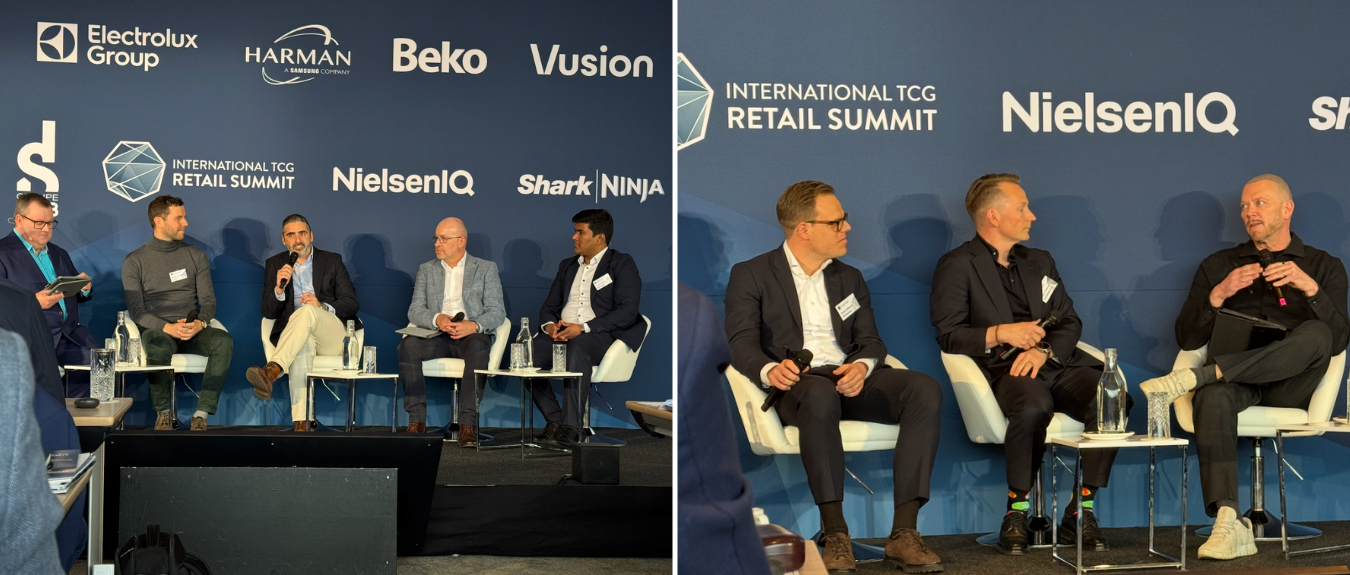
Here is Ulrika Theander Managing Director Smeg Nordic, take aways from TCG Summit 2026 in Copenhagen.
For two days, some of the industry's biggest names, globally, Europe and the Nordics, gathered at TCG Summit 2026 which was held this year in Copenhagen. With a robust program of speakers and guests, they covered everything from today's volatile macroeconomic environment to the upcoming generational shift among our consumers, from boomers to Gen X, Millennials and Gen Z.
A common thread throughout the days was: What will be required of us and how do we build the retail of the future and how do we manage to win the battle for consumers' attention.
Business analysis
The message from the industry's latest meeting place, TCG Summit 2026, is clear. We operate in a VUCA world where change is no longer the exception, but the norm. At the same time, the macro picture points to an unusually difficult situation to navigate. Assessments from leading players, including Morgan Stanley, describe the coming economic cycle as one of the most difficult to assess in a long time – a time of regime change.
Furthermore, the effects of energy and commodity markets will be long-lasting. Europe is particularly vulnerable to energy crises, and even if oil and gas markets stabilize quickly, the impact will persist. At the same time, European consumers have not yet fully returned to their pre-pandemic behaviors, which continues to dampen demand and change purchasing patterns.
In parallel, digitalization is accelerating. AI has established itself as a new point of purchase and its importance is expected to increase exponentially. For suppliers, this means new requirements: content, specifications and offers must be optimized – not only for people, but also for algorithms that increasingly influence purchasing decisions.
New consumers, new expectations
At the same time, we are in the midst of a generational shift that requires active preparation and understanding. From Boomers to Gen X, Millennials and Gen Z – each group is changing the playing field. Where Boomers were characterized by brand loyalty and Gen X is more campaign and recommendation-driven, Millennials represent a hybrid behavior: digitally mature, research-driven and value-oriented. They compare, read reviews and expect transparency, but are also willing to pay for perceived value, sustainability and convenience. Winning this group requires more than price – it requires relevance, credibility and a seamless shopping experience.
This is also reflected in how commerce is being redefined. We no longer operate within a single channel, but in an ecosystem of several parallel forms of commerce:
- Retail continues to play a central role, but more as an experience and service hub than a pure transactional place. The future of retail is predicted to belong to brands that design emotional, human-centered experiences.
- E-commerce is still a strong base, where efficiency, accessibility, credibility and comparability are clear hygiene factors.
- Agentic e-commerce is emerging where AI acts as an intermediary in the purchasing process, making decisions based on data and preferences. Agentic AI is on its way to redefining everything from consumer shopping to internal retail operations. And can our companies figure out how to unleash its full potential?
- Social commerce drives demand through inspiration – where consumers' attention becomes hard currency. This means that the entire shopping experience – from inspiration to purchase – takes place on platforms such as TikTok & Instagram.
- Recommerce reflects a shift towards circular business models where sustainability and price meet.
For suppliers, this means not only more channels – but fundamentally different ways of influencing and meeting the customer, at every step.
Against this backdrop, simplicity, seamlessness and access to the consumer’s attention become crucial competitive advantages. The player who manages to make the buying journey smooth, relevant and secure – regardless of channel – gains ground. At the same time, the bar is being raised by new, global players, combining advanced logistics, local adaptation and services such as installation and support.
But perhaps most telling is the insight into value. When a dinner for two, at a fine restaurant, can be compared to the price of a washing machine, our pricing, positioning and communication are put in a new light. The question is not just what we sell – but how we justify why it is worth it.
The conclusion is clear: it is not the spender who wins in this market, but the spender who spends smartest. Those who understand the interplay between macroeconomics, technological developments and changing consumer behavior – and act quickly – will not only weather the turbulence, but come out stronger on the other side.

Ulrika Theander
Managing Director
Smeg Nordic