

2022.11.08
Guest writer: New student support could be the solution to the skills issue
On October 1, a new state student aid for skills development was introduced. The Swedish Technology Companies' unit manager for skills supply, Frida Andersson, believes that the new student aid for transition could be one of the solutions to skills supply for industry. Read her reasoning below.
The supply of skills has been the biggest obstacle to growth for Swedish companies for many years. 8 out of 10 industrial companies state that their operations have been affected by the difficulties in finding the right skills. The consequences are that companies cannot maintain the pace of development they want and Sweden misses out on job growth. Neglecting qualifications and skills and doing too much will ultimately lead to poorer productivity. The skills most in demand are automation technicians, industrial electricians and repairmen. Among engineers, there is a major shortage of skills in software and systems science.
Climate change, new technology and digitalization place high demands on companies to keep up with developments and change rapidly. This in turn places high demands on companies to develop the skills of their co-workers and on individuals to continue and further their education. The need for skills development has increased in the last five years. The larger member companies of Teknikföretagen state that half of the employees need major skills-enhancing efforts in the next three years, which corresponds to approximately 80,000 people.
One piece of the puzzle is the new transition study support that was introduced on October 1st of this year. This gives basically all employees in Sweden the opportunity to realize their own knowledge boost.
What does the transition study support mean?
The reform means that people who are in working life are given the opportunity to train with financial compensation to develop within their existing job or to change careers completely. The purpose of the new support is to provide the opportunity to strengthen people's position in the labor market - now and in the future. This concerns, for example, the metal worker who, in the middle of life, with family and the whole middle class, decides to train as a service technician and is then given the support needed to succeed.
Student support can be provided for up to 44 full-time weeks, as long as the person meets certain requirements. Among other things, the person must have worked for at least eight years and in the recent past. The employee is entitled to receive up to 80 percent of their income, but with a ceiling. If you work for a company that is a member of a collective agreement, you can receive a higher amount.
However, it is not possible to further train for just any job. The training must strengthen the individual's future position in the labor market, taking into account the needs of the labor market, either within the same industry or a new one. The training must not be of a "hobby nature" or solely benefit an individual employer.
The study grant is linked to the individual, not the company. The opportunity for further education with the adjustment study grant does not replace skills development in the workplace. The intention is that the study grant should function as an increased level of security for employees. This should be seen in relation to the changes to the LAS, which mean more flexibility for the employer. However, companies can benefit from being clear about what needs they have, so that employees know what type of skills the labor market demands.
Adapt training for professionals
The transition study support is in the start-up phase. It is currently possible to apply for courses starting in the spring. The next step is for the education system to start adapting more to people who are already working.
For example, some people would like to work part-time and study in parallel. The system is not currently set up for this type of short, flexible education. Previously, we spent many years in school at a young age and then worked our entire working lives. That is no longer the reality for business and the labor market. Action is needed in education policy. For a person who is in the middle of life, effective and flexible education is needed. Preferably digital. An important part is to continue expanding the university of applied sciences and its short courses.
Interest in skills development and transformation
Do people want to further their education?
In August, the technology companies conducted a survey using a demoscope where 4,051 people answered questions about further education and training, its drivers, obstacles and interest.
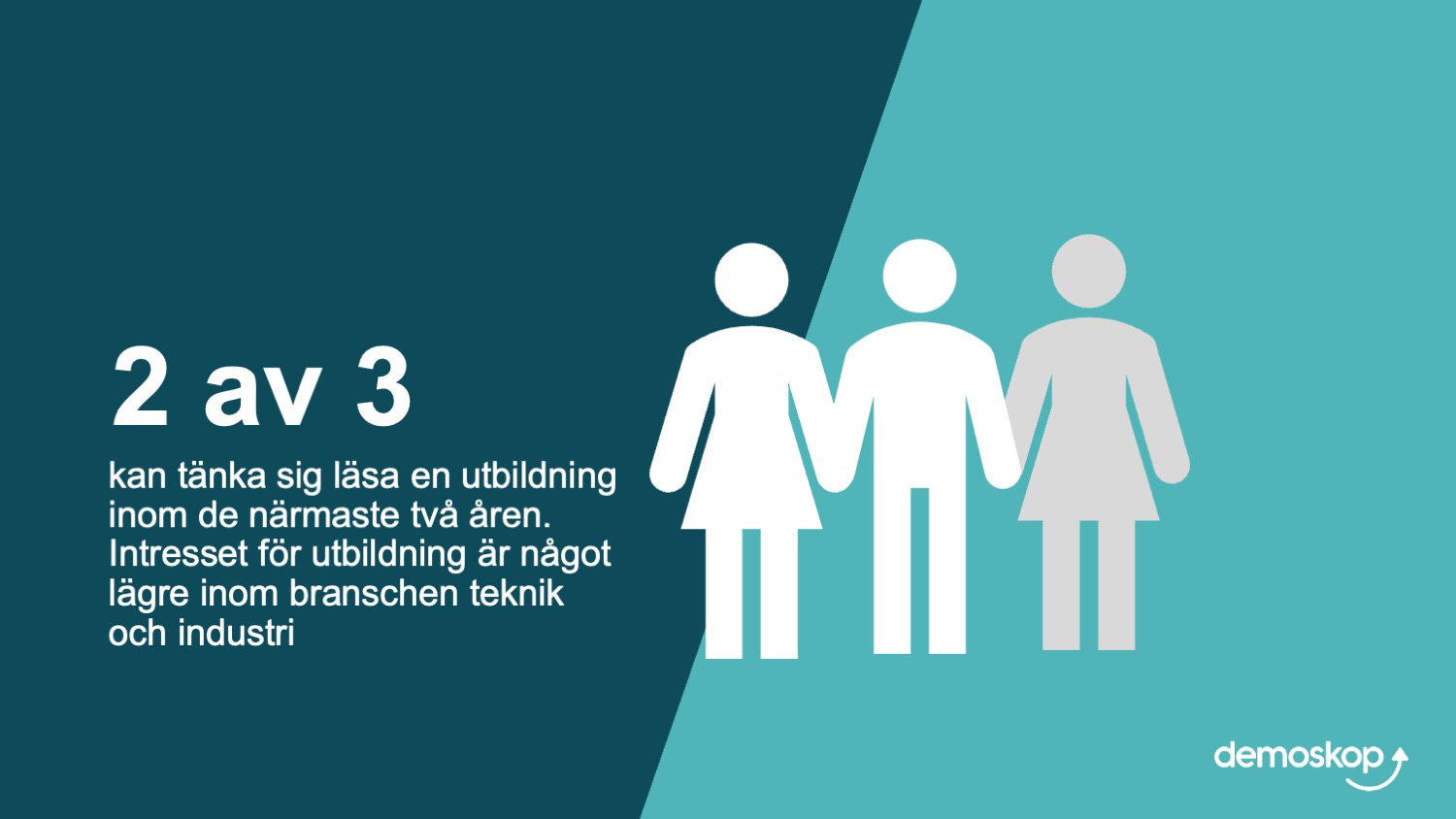
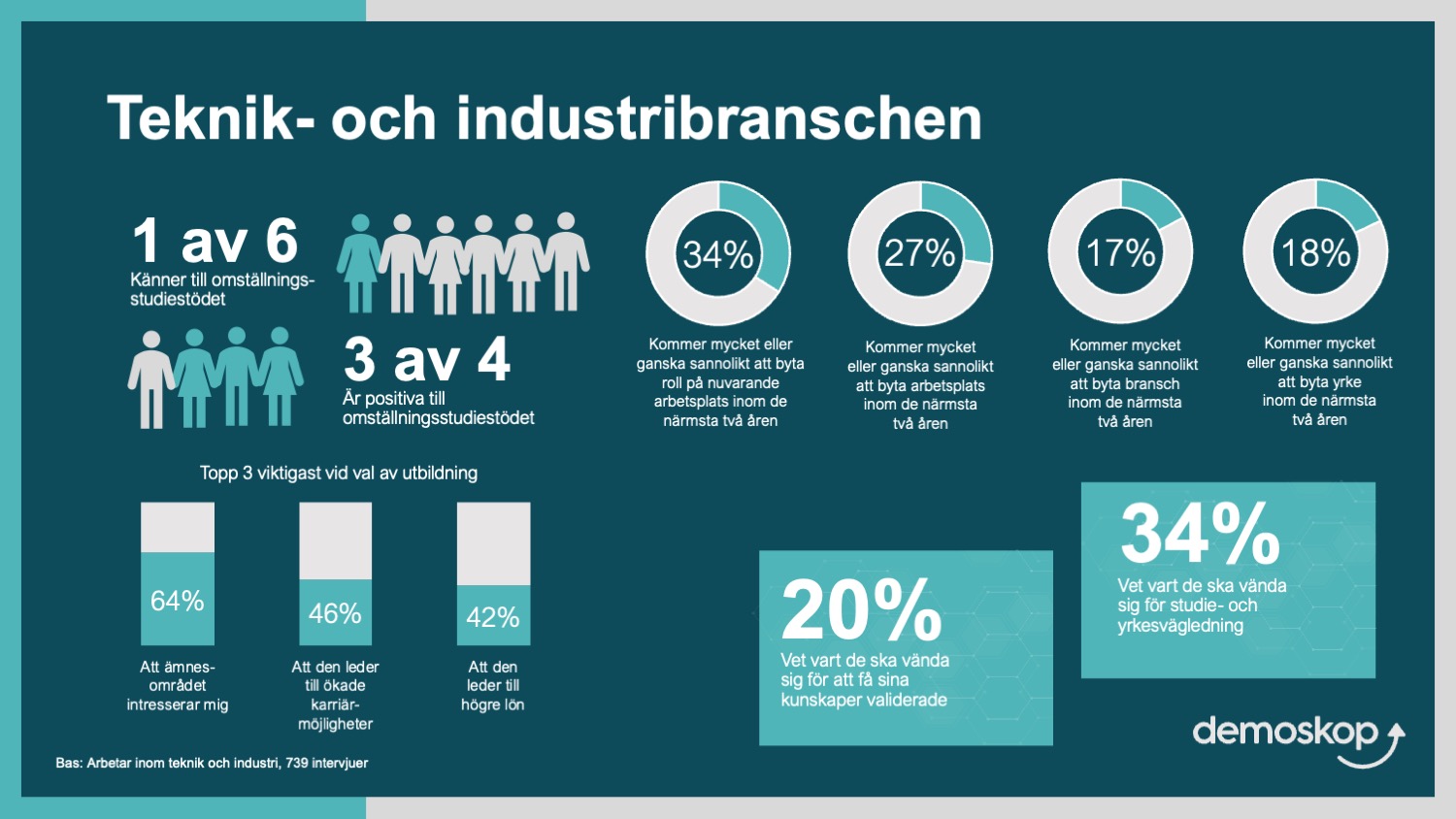
The result shows that among those currently working in the industrial sector, 2/3 would consider pursuing an education within the next two years.
Why do they want to study?
The driving forces are interest and the opportunity for career development. However, there we can see major differences between white-collar workers and professional workers, where white-collar workers focus more on education being interesting, fun and helping with specific skills. For professional workers, it is primarily about increasing their salary or being able to change jobs.
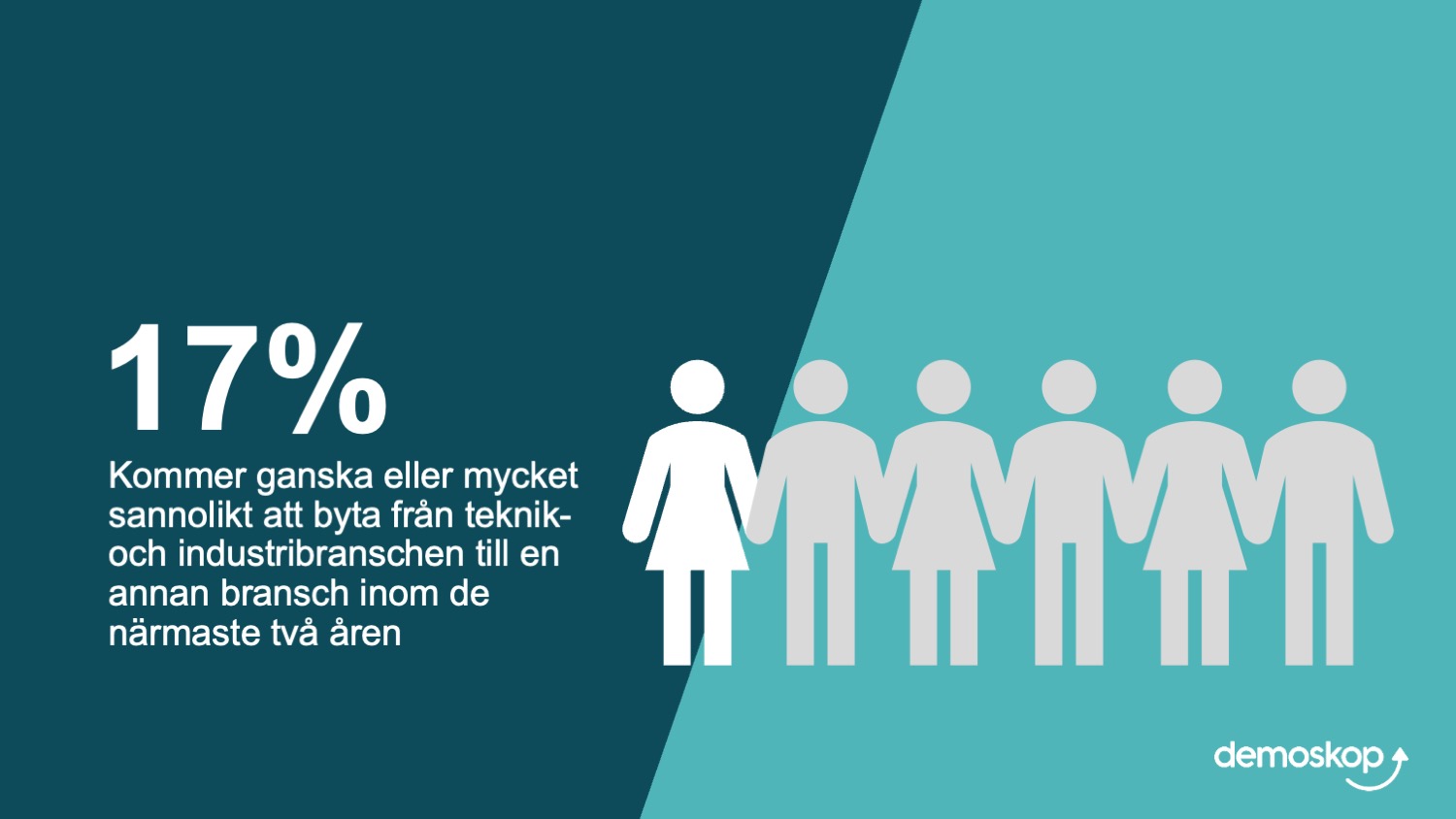
Many who currently work in industry also want to continue working in the industrial sector. In general, industry is perceived as an attractive industry and many want to study technology-oriented education, both among those who currently work in the industry and among those who currently work in other industries. Industries where most people state that they want to study for industry are the energy industry, the pharmaceutical industry and construction and civil engineering.
Where do they want to study?
The type of education one is interested in studying is strongly dependent on one's educational background. Among those who have previously been in higher academic education, they are much more interested in studying at a college/university.
Around half of everyone in the industry wants to study for a year or longer. Professionals are more likely to consider taking longer courses.
One of the biggest differences between education later in life compared to directly after high school is how relevant vocational colleges are. Among those already in the job market, vocational colleges are almost as popular an option as colleges and universities. 2/3 of those working in industry today can imagine vocational colleges as a form of education.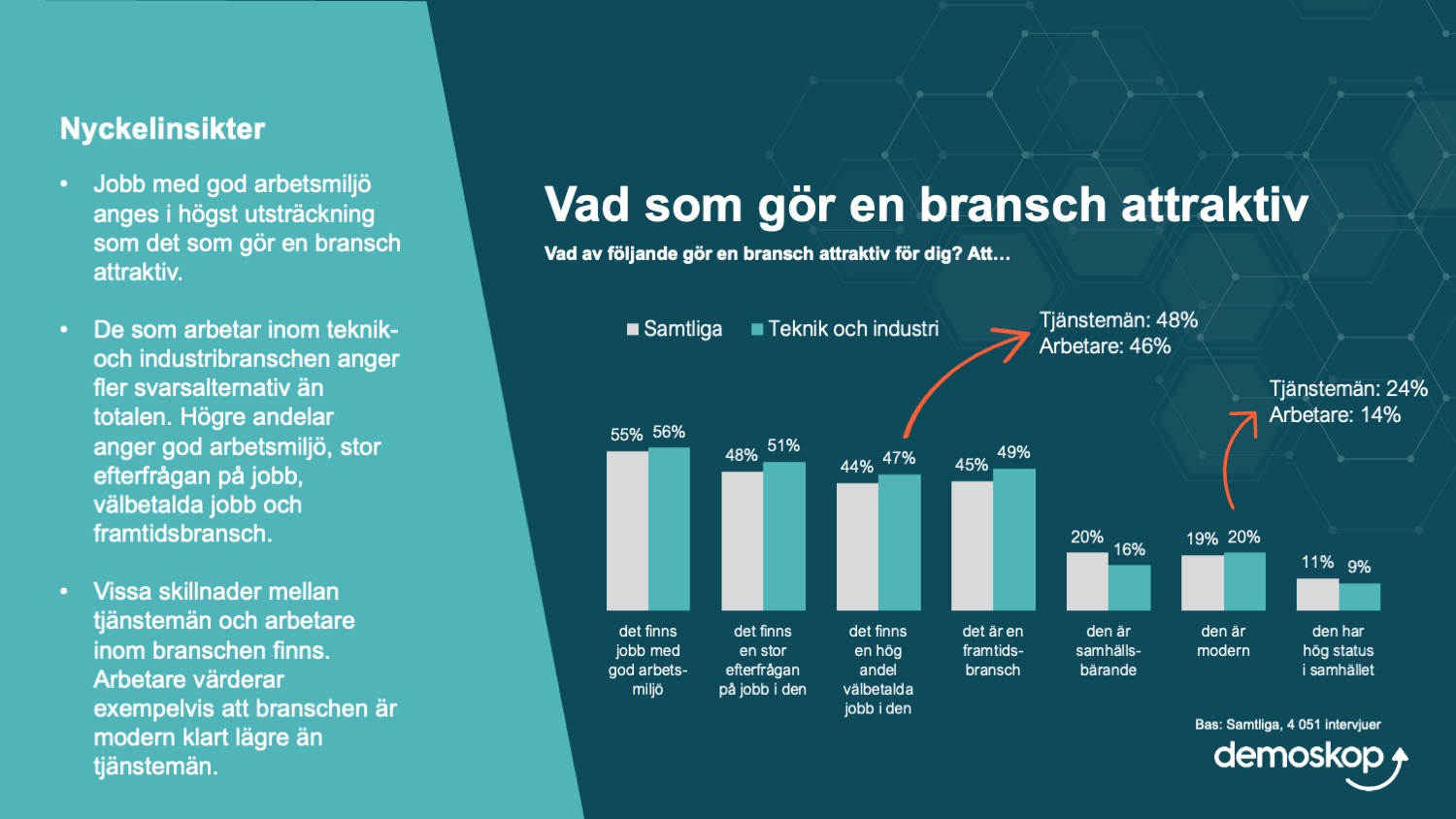
What is required for you to be able to study?
Salary and time are the biggest constraints. Therefore, it is not surprising that maintaining a salary is what most people say would make them more likely to start an education.
More than a third state that the opportunity to study distance learning had increased the likelihood that they would begin an education.
/Frida Andersson, Head of Skills Supply, Technology Companies
