

2023.12.18
New manifesto for a fair, sustainable and prosperous EU
Applia Europe has developed a new roadmap with practical recommendations for the European Commission, the European Parliament and national governments up to 2030. The plan is divided into three parts – enabling the transition to a climate-neutral Europe, supporting citizens in the transition and preserving jobs and promoting growth in Europe. Applia Sweden has taken a closer look at the manifesto and recommendations to see how they can be applied in Sweden. First up are measures to promote the transition to a climate-neutral Europe.
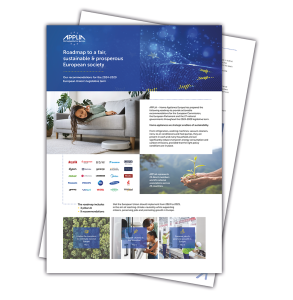
Read the manifesto in its entirety here.
Home appliances are strategic enablers of sustainability. From refrigerators, washing machines, vacuum cleaners and irons to air conditioners, they are found in every household and can significantly reduce everyone's energy consumption and carbon emissions, provided the right conditions are provided for the companies that develop the products and the consumers who buy them.
Recommendation 1 – A decarbonisation plan for Europe
The incoming European Commission should present a plan, already in its first 100 days in office, to reduce the Union's carbon emissions. Such a plan would complement the Green Deal strategy but with a strong focus on implementation to achieve the 2030 and 2050 climate targets. The decarbonisation plan should also aim to identify, accelerate and reward all possible technologies that contribute to reducing carbon emissions in Europe.
— APPLiA Sweden's member companies are at the forefront of innovation and technology, and therefore a complementary plan to the Green Award, which specifically rewards green innovation, would benefit companies and strengthen competitiveness, says Applia Sweden's CEO Matts Spångberg.
Recommendation 2 – Enable and reward carbon transition investments
The second recommendation of the manifesto proposes a new framework for transition finance that should complement the EU’s previous sustainable finance agenda. The proposed aim is to enable and reward all possible investments that aim to reduce carbon emissions. The financial system should not only reward green assets; it should actively enable the transition of all sectors towards sustainability.
"It is important that in all areas where they want to get consumers to change, they find the right stimulus measures that suit each industry and achieve the best environmental benefit for the maximum savings effect," says Matts Spångberg.
Recommendation 3 – Modernize the energy system to reduce CO2 emissions and costs
The final recommendation of the first part calls for measures that modernize our energy system to permanently reduce carbon emissions, energy consumption and costs. Energy consumption can, and should, be optimized with smart and efficient devices, such as modern household appliances.
— New appliances have significantly lower energy consumption than older ones. We can therefore conclude that the industry is doing its bit. But we must ensure that the energy consumed is green to a greater extent and that the energy system is modern and efficient to avoid bottlenecks and cost peaks for consumers. In other words, this recommendation requires a joint effort by producers and decision-makers, says Matts Spångberg.
If we are to achieve climate neutrality by 2050, we need to enable and accelerate all ways to reduce carbon emissions. Today, over 80 % of primary energy comes from fossil fuels and only 3 % from renewable energy. This means we need to double the progress in energy efficiency to avoid an even greater climate catastrophe. Home appliances play a crucial role in getting there. Our industry is continuously delivering more energy-efficient products that make a real difference. Now we hope the Commission will do its part.
Text: Ellenor Österberg