

2022.03.09
Keep up with industry trends – part 3
In previous APPLiAnytt we have covered the latest product trends in the industry. household appliances (SDA) and parts of the MDA segments. Now comes the third and final part of our series where we present some of the industry's most important product trends and this time focus on the segments of the home's most central helpers - STOVE, OVEN, HOB and FAN.
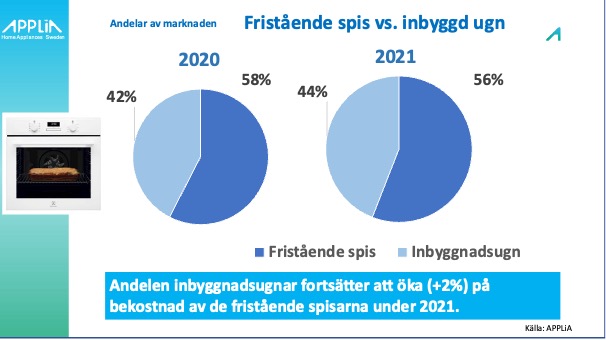
Built-in ovens are gaining market share
In the fight between freestanding stove options and built-in ovens, it is built-in ovens that are accounting for an increase at the expense of traditional stoves. In 2021, ovens have caught up with stoves by another 2 percentage points and are now trailing freestanding stoves. The growth of built-in ovens is a trend we have seen for many years and is expected to continue for many years to come. The built-in ovens that are sold also often have a higher degree of innovation than many traditional freestanding stoves. We can see the shares of some such innovative features in the next picture:
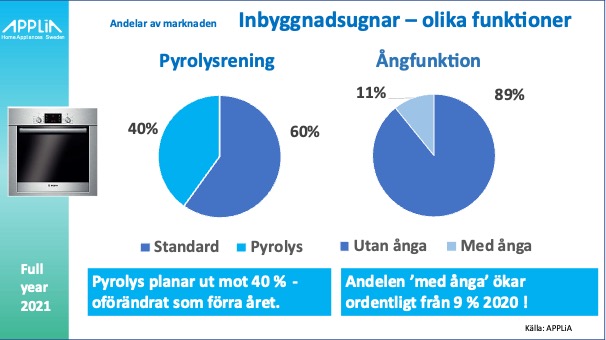
Ovens – with many useful functions
PYROLYTIC CLEANING of the oven cavity is a function often requested by users. It makes cleaning the oven significantly easier and in a few years their share has grown significantly in connection with the increase in product range and demand on the market. However, in 2021 the increase will take a short break with an already high 40 percent share. The forecast is that the share of pyrolysis will increase again in 2022.
Ovens with STEAM FUNCTION are showing solid growth in 2021, with the share growing by a full 2 percentage points. With today's share of 11 percent, it is still a long way from becoming a dominant function to be reckoned with. Users appreciate the steam function, which has multiple uses in cooking, baking and cleaning, so we definitely expect continued growth in the coming years.
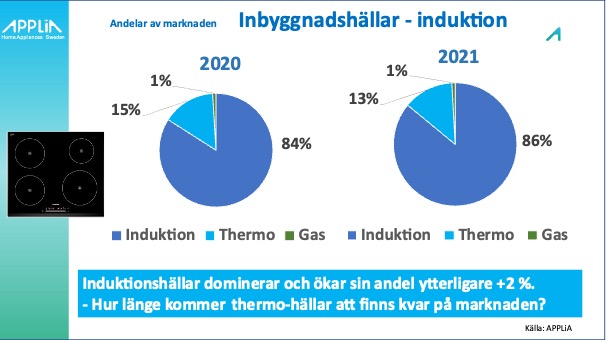
Hobs – induction totally dominant
The super-fast and energy-efficient INDUCTION TECHNOLOGY is completely dominant in the market for built-in hobs – and it is also growing in proportion to 86 percent in 2021. The future of hobs with thermotechnology (traditional heating elements) looks to continue to be in a strongly shrinking phase when it comes to built-in hobs.
The induction wave has taken off in Sweden over time. In 2006, the share was only 29 percent, but in 2010 it reached 43 percent and now stands at 86 percent. Consumer acceptance of induction technology is very high when it comes to hobs in new kitchens, but also for replacement purchases. Once you as a user have become accustomed to the lightning-fast induction technology, you don't want to be without it. Not even in the summer house.
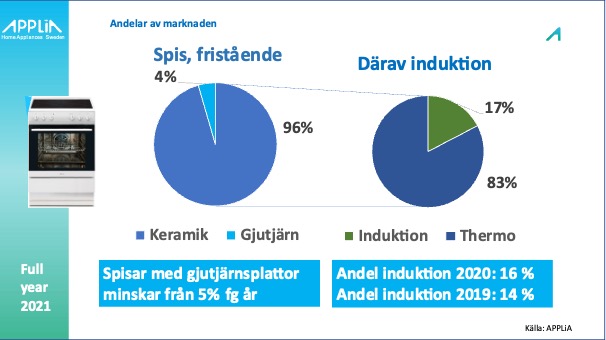
Will cast iron plates soon only be in museums?
CERAMIC HOBS on freestanding cookers have completely relegated cookers with traditional cast iron plates to an almost insignificant role in the market. The market share of these traditional cast iron plates is now less than 4 percent and the decline indicates a complete acceptance by buyers of ceramic hobs on freestanding cookers in all cooker widths; 50, 60 and 70 centimeters.
Stoves with ceramic hobs can also accommodate induction technology, but here the share of 17 percent is still at a low level. The share is growing by a few percentage points every year, but it is a long way to the same position as for built-in hobs. However, with an increased range of induction hobs and a lower price level that now starts around SEK 7,500, stronger growth of induction hobs is predicted in the future.
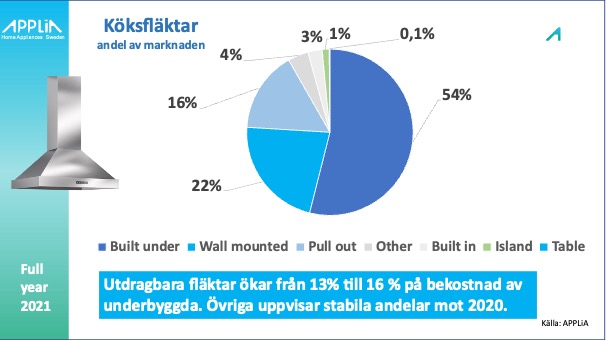
Retractable fans increase
The fan market in Sweden is characterized by a wide range of different fan types. The largest market shares are held by the built-in fans, followed by the wall-mounted ones. In third place in size on the market are the fan types that increase their sales share the most in 2021; the EXTENDABLE FANS, which increase from 13 to 16 percent. This is happening entirely at the expense of the built-in fan types.
This entire segment of kitchen hoods is now and in the future facing increasing competition in terms of market share from built-in hobs that contain a built-in fan, so-called down draft hobs. If they were included in the fan category, they would already statistically constitute a full 4 percent of the fan market.
Kent Oderud, Chairman of APPLiA
Image: Frank Zhang/Unsplash