
2023.01.24
Industrial innovation, sustainability and service growth
2023 began with CES, the Consumer Electronics Show, in Las Vegas – a mecca for product news and technical innovations. Applia naturally covered the trade fair organizer CTA's trend scouting and the member companies' press conferences. Below is a selection of the trade fair's extensive content.
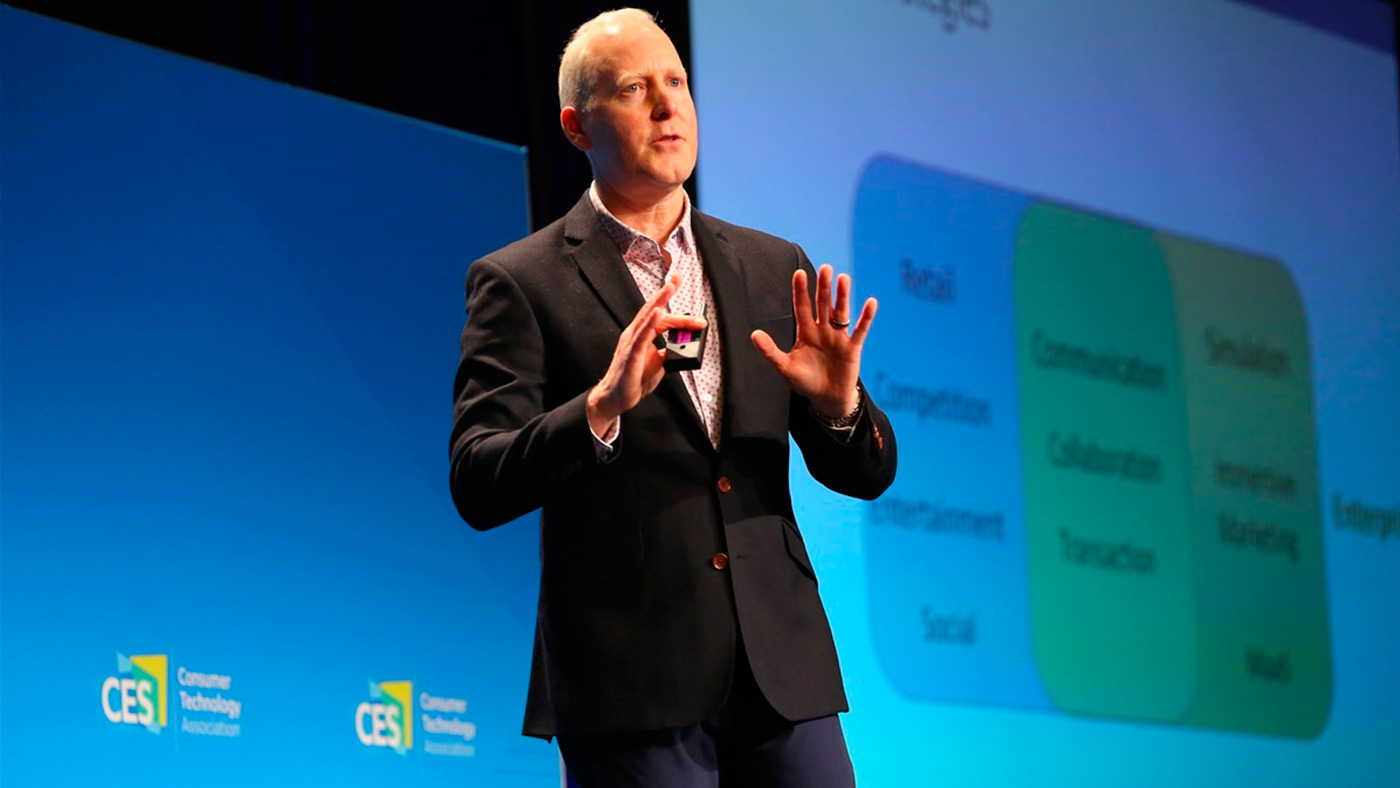
More than 3,200 exhibitors, including 1,000 startups, showcased their innovations to 4,800 media representatives and 115,000 visitors in Las Vegas in early January. During the show, Steve Koenig, vice president of organizer CTA, spoke about trends and technologies to watch for during the year.
Steve Koenig highlighted enterprise technology in particular as an area of rapid development. In addition, many of the innovations are being developed within start-ups. For example, there is rapid development in 5G in terms of IoT applications for industry – for example in Connected Intelligence, Autonomous Systems and Quantum Computing.
In 2022, a number of standard protocols for 5G were nailed down, which are considered by many to be the starting point for industrial IoT applications, and 5G is the first wireless standard where it is precisely industrial apps – rather than consumer apps – that lead the way forward.
Home Health Hub is another area that Steve Koenig mentioned where development is happening quickly. The high capacity and low latency of 5G enables things like remote health monitoring, digital access to doctors with 24/7 virtual doctor visits, and more, and in the closely related area of Fitness Tech, connected workouts combined with new products mean we can have a whole new gym experience at home. Air purification and Food Tech were also pointed out as two innovative areas.
Steve Koenig also mentioned that services continue to grow. In 2019, services accounted for 22 percent of US Tech revenue, while hardware accounted for 78 percent. Last year, services accounted for 30 percent, and this year they are expected to account for 31 percent of revenue – so soon services will account for a third of sales and hardware for two-thirds.
Tanja Ruckert, Bosch Photo: CTA
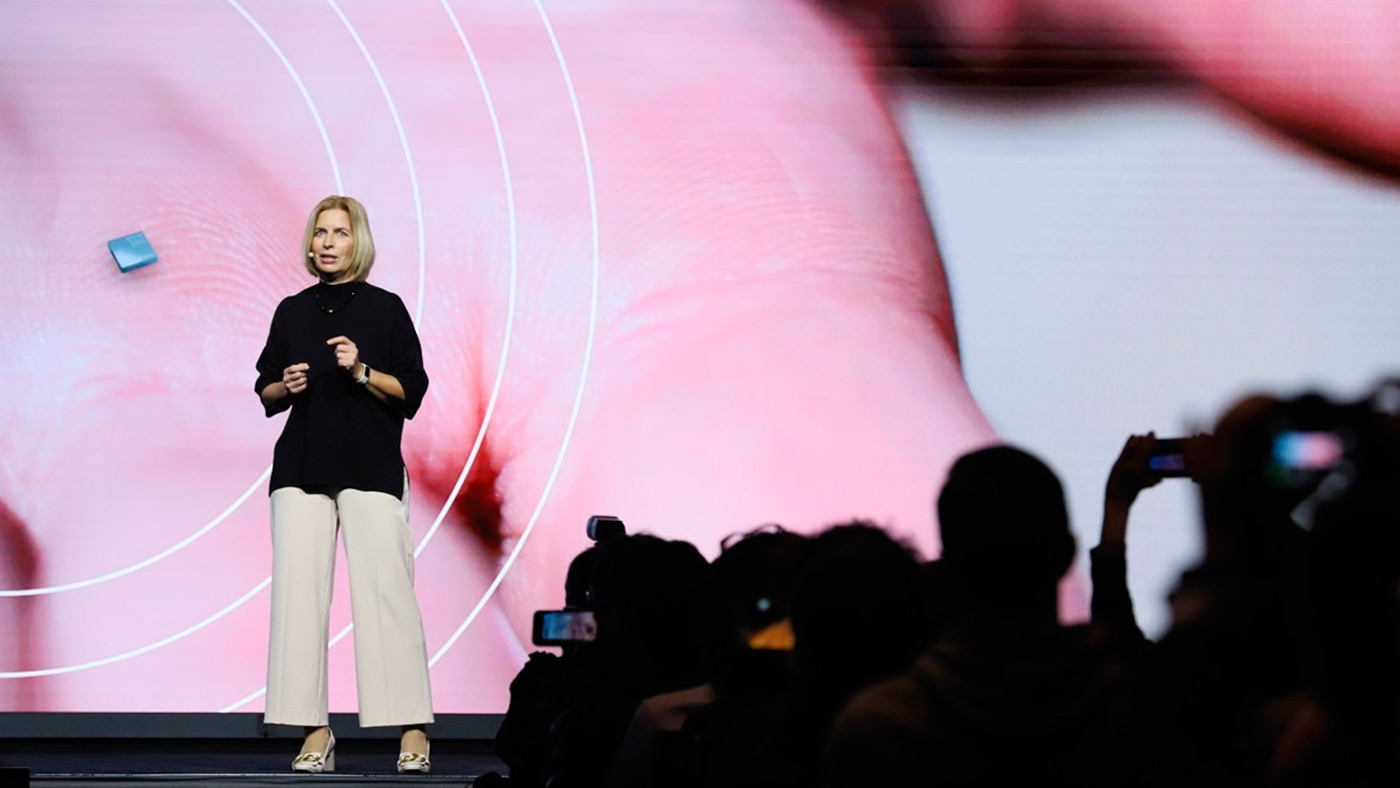
”"Live LikeABosch – With many small and smart sensors for big effects"”
During Bosch's press conference at CES 2023, there was a big focus on sensors, or Microelectromechanical systems (MEMS) as Bosch calls its small sensor products.
Dr. Tanja Rückert, Bosch chief digital officer, said that the new pressure sensors in smartphones can show altitude with an error margin of a few centimeters, which is useful, for example, in an emergency situation in a skyscraper because it is possible to quickly locate which floor the mobile phone, and hopefully also the person, is on.
Dr. Tanja Rückert also said that the new MEMS sensors for measuring air quality are 450 times smaller than previous equivalent products on the market, which of course makes it much easier to install them in a variety of different products.
There are an average of 22 MEMS in every car sold, and at least one MEMS in every second smartphone sold in the world. Now there are MEMS with AI, and the latest Bosch is working on is Quantum Sensors, which are 1,000 times more precise than today's MEMS.
A collaboration between Bosch and Mercedes-Benz has recently resulted in Stuttgart Airport becoming the first in the world with an authority-approved driverless parking system – and there are certainly many who would appreciate the function of driving to the airport entrance and unloading their luggage, only to then see their car drive away on its own and park in the parking garage.
Jong-Hee Han, Samsung Photo: Samsung
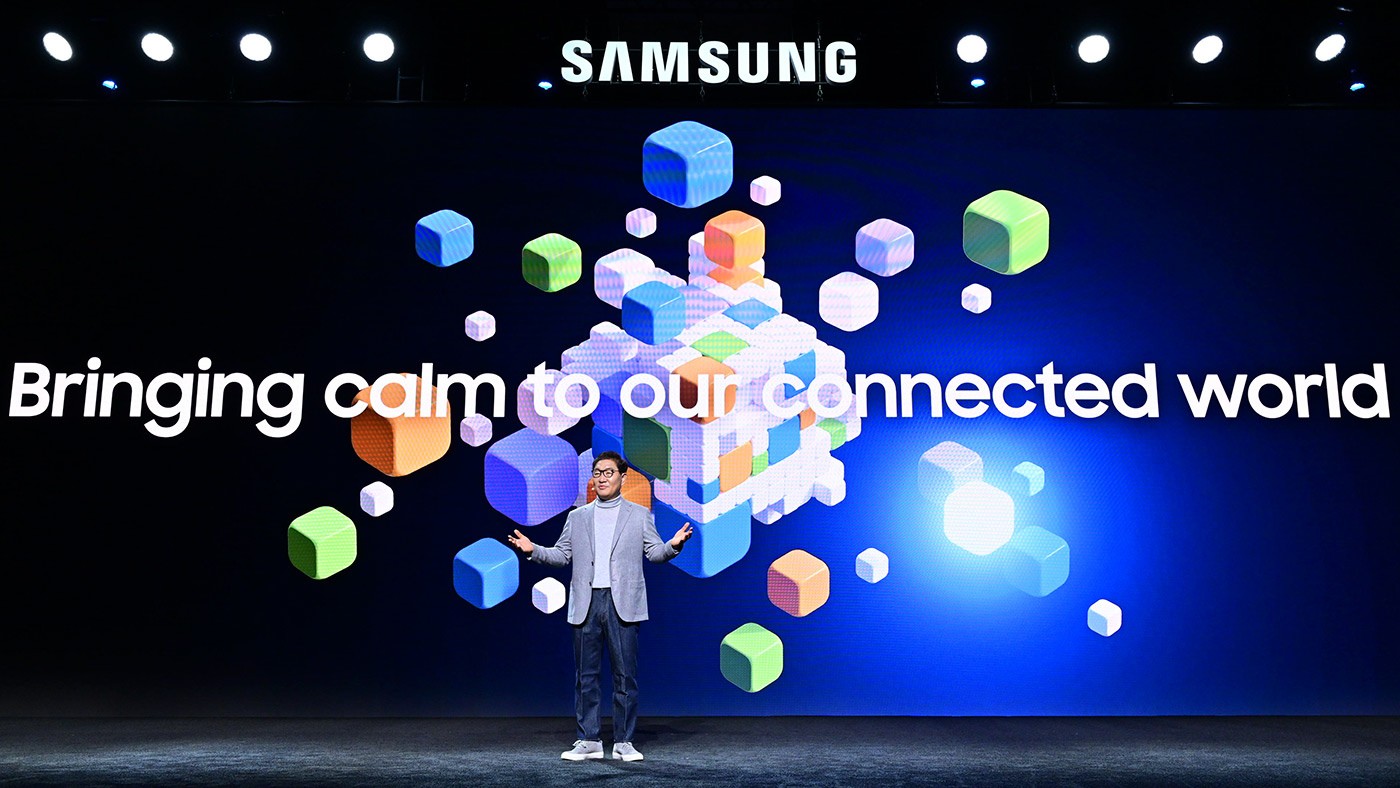
”"Bringing calm to our connected world"”
Jong-Hee Han, Vice Chairman, President and Head of Device eXperience (DX) Division at Samsung, spoke at the company's press conference about the company's goal to create peace of mind in our connected world, so that devices and innovation can truly enable better, more personal and intuitive experiences.
Samsung highlighted how it continues to work to find new solutions to reduce its environmental impact through a combination of innovative product design and strategic partnerships. As a result, by 2050, Samsung’s entire business will match its electricity needs with renewable energy and achieve net-zero carbon emissions. In the shorter term, the DX division will transition to 100 percent renewable energy by 2027 and achieve net-zero carbon emissions by 2030.
One focus area that will advance Samsung's sustainability goals is everyday sustainability, building sustainability features into the company's most popular products and services. This includes creating more sustainable products through innovative design in materials and energy efficiency.
Samsung said that many of its TVs and smartphones use recycled materials, including recycled plastic from discarded fishing nets, while Samsung's connected services, such as SmartThings Energy and AI Energy Mode, help consumers save energy. Overall, the company's nearly 80 million SmartThings users are undeniably impacting the company's environmental impact.
Samsung is also focusing on reducing its environmental impact in the washing machine sector. In 2023, the company will launch a microfiber filter for washing machines, and not just its own. Samsung also announced that it has partnered with several leading companies in sustainable technology development to develop the industry's first specification to measure, report and reduce the carbon dioxide emissions associated with connected products when used by consumers.
Text: Ola Larsson