
2022.01.11
More infections in poorly ventilated premises
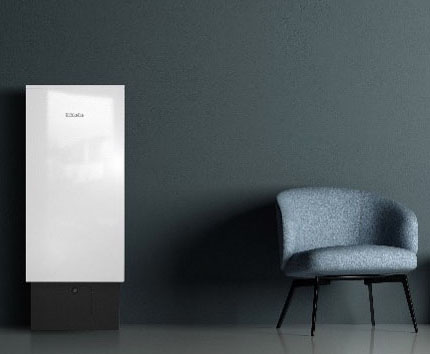
With the corona pandemic, air quality and ventilation have become current topics and several studies show that in poorly ventilated classrooms, for example, more people become infected than in rooms with better air quality. It has also been proven that air purifiers reduce the risk of infection. APPLiAnytt asked Jacob Littorin, Miele AB, some questions about air purifiers.
You have previously been able to read about the bright future for products that improve air quality and the increasing demand for healthy solutions for both homes and larger premises in APPLiAnytt (click here). We have also been able to read about studies that show the connection between Covid infection and air quality and how authorities in e.g. Belgium, Ireland and Germany are currently acting on the benefits of healthy air quality in, among other things, schools and elderly care. In Hamburg, for example, all classrooms have been equipped with effective air purifiers during the past autumn holidays. All to combat the continued ravages of the Covid virus among schoolchildren and educators.
Air purifiers reduce the risk of infection
Now another study from the world of schools, this time from Switzerland, shows that the risk of being infected with covid-19 is higher in classrooms with poor ventilation and without air purification. The study was carried out as a pilot project with researchers from the Empa institute in 150 different classrooms in the province of Graubünden and is one of many scientific studies that conclude that poor indoor air quality increases the risk of spreading infection. In poorly ventilated classrooms, more people were infected than in rooms with better air quality. In addition, the air quality measurements show that the majority of the classrooms included in the study had elevated levels of CO2 (carbon dioxide). In 60 percent of the classrooms, the CO2 level exceeded 2000 parts per million (ppm) and there were rooms that were above 3000 ppm. The recommended level for premises is around 1000 ppm. Elevated CO2 concentrations can impair cognitive performance and thus learning ability. A statistical correlation between the number of positive cases in the weekly school tests and the measured CO2 concentration in the corresponding classrooms could be established. In addition, significantly more individuals were infected with SARS-CoV-2 in poorly ventilated classrooms.
In Sweden, we have comparatively good ventilation in our homes and premises. Most workplaces have a functioning ventilation system, but many homes only have natural ventilation. However, it is still a fact that our indoor environment is often up to 50 times more polluted than the outdoor air – and has a higher level of CO2, especially in winter.
A good air purifier can create a significantly cleaner indoor environment in a matter of minutes by filtering out 99.995 percent of aerosol particles. This significantly reduces the risk of exposure to infections.
VThe semester has begun…
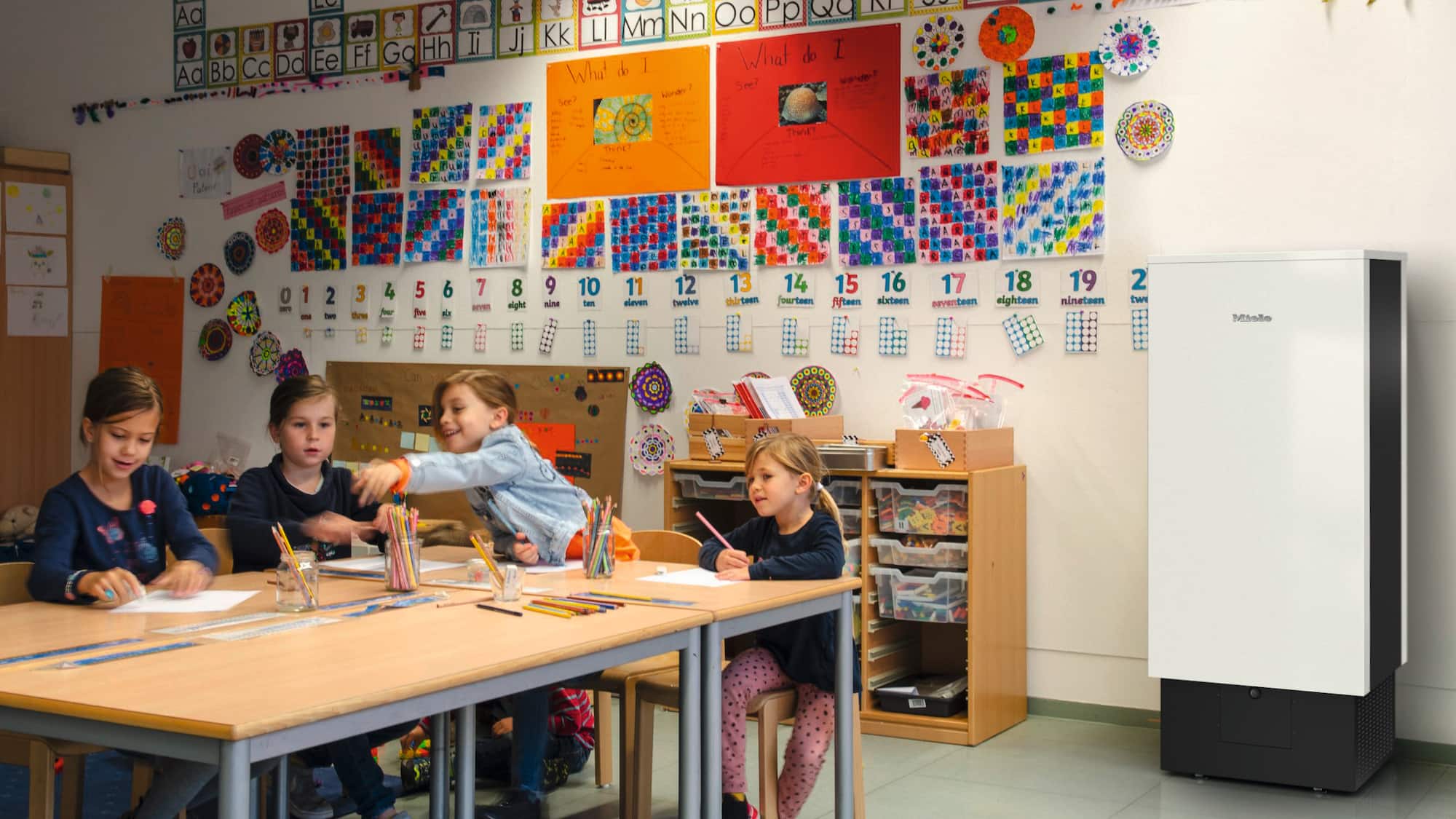
The spring semester has just begun in Swedish preschools, primary schools, upper secondary schools and universities, and many in the teaching world are now expressing concerns about the risk of spreading omicron and Covid-19 after the Christmas and New Year holidays. APPLiAnytt therefore asked Jacob Littorin, Marketing Manager for Miele Professional, who has just introduced a series of effective air purifiers for premises from 40 m2 up to 200 m2, about any procurements within school values or other public matters and what is otherwise happening in the Swedish market.
 Are there any procurements currently underway in the school world or other public sector regarding this product category in Sweden?
”"Not at the moment. In other countries, they have come further in that regard. For example, the city of Hamburg installed our mobile air purifier in over 1,500 classrooms during the autumn holidays to prevent the spread of infection among students and school staff," he says. Jacob Littorin, Miele AB.
What does the intended customer profile look like for your air purifiers in Sweden?
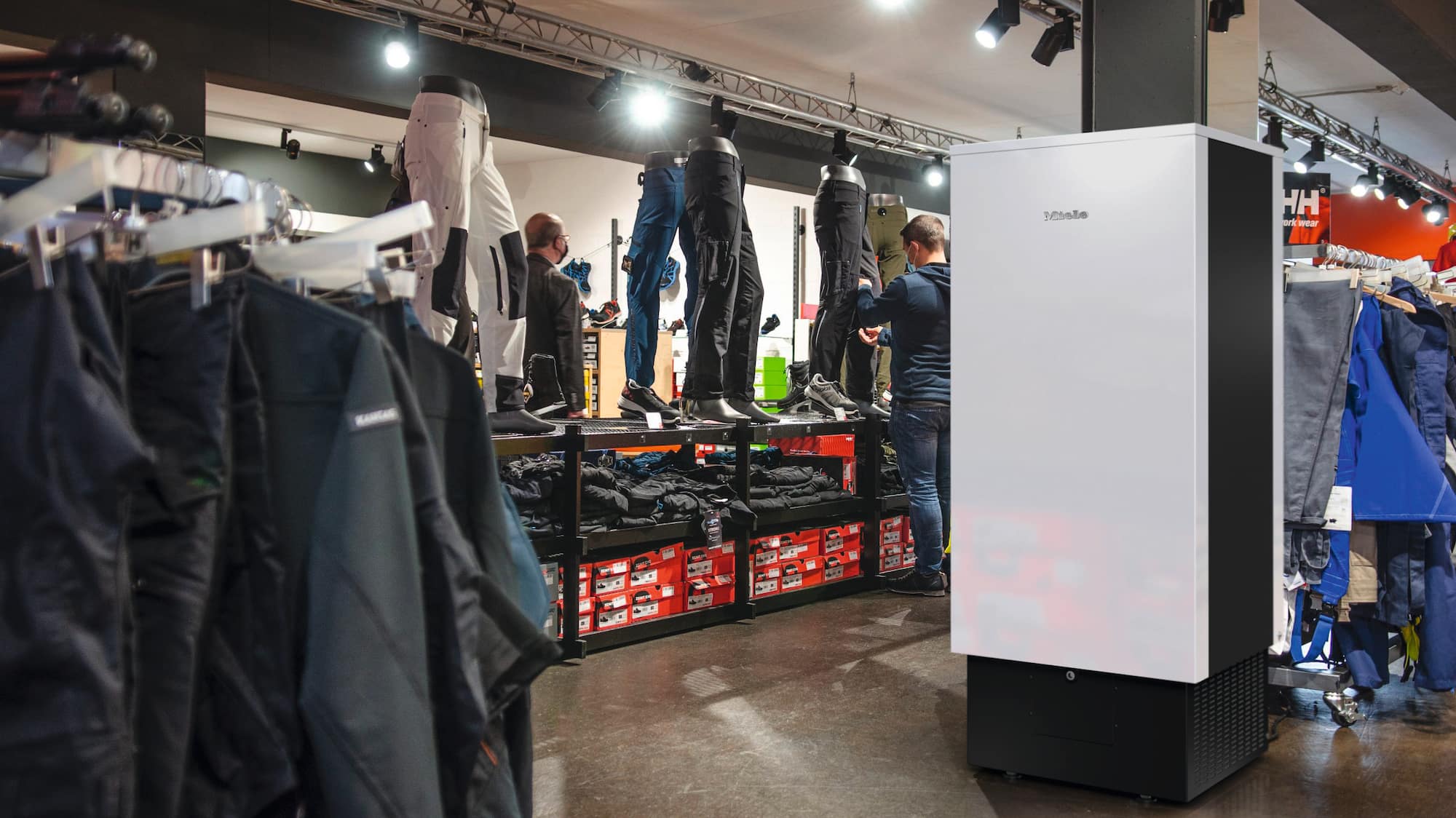
”"Public or private indoor environments where many people are present, such as in classrooms, lecture halls, kindergartens, receptions and waiting rooms, offices, gyms, hairdressers, shops, in elderly care, etc. The advantage of Miele's professional air purifier is the high capacity (6 air changes/hour) while it is robustly constructed (including tamper-proof and tip-proof) and easy to place. In addition, it blends well into most environments with its award-winning Red Dot design."”
Does Miele also see any business opportunities in Swedish households for this type of product?
”"Our series of air purifiers are primarily developed for the professional market. That is, various types of public or private premises (45-200m2 depending on model) with a lot of people on the move, but of course our air purifiers can also be installed in villas and other homes. It is completely Plug&Play-compatible and only requires a regular 230v outlet."”
Approximate price for the smaller air purifier PAC 1045 intended for rooms up to 45 m2?
”The recommended price is SEK 28,450 excl. VAT.”
How does the air purifier itself work?
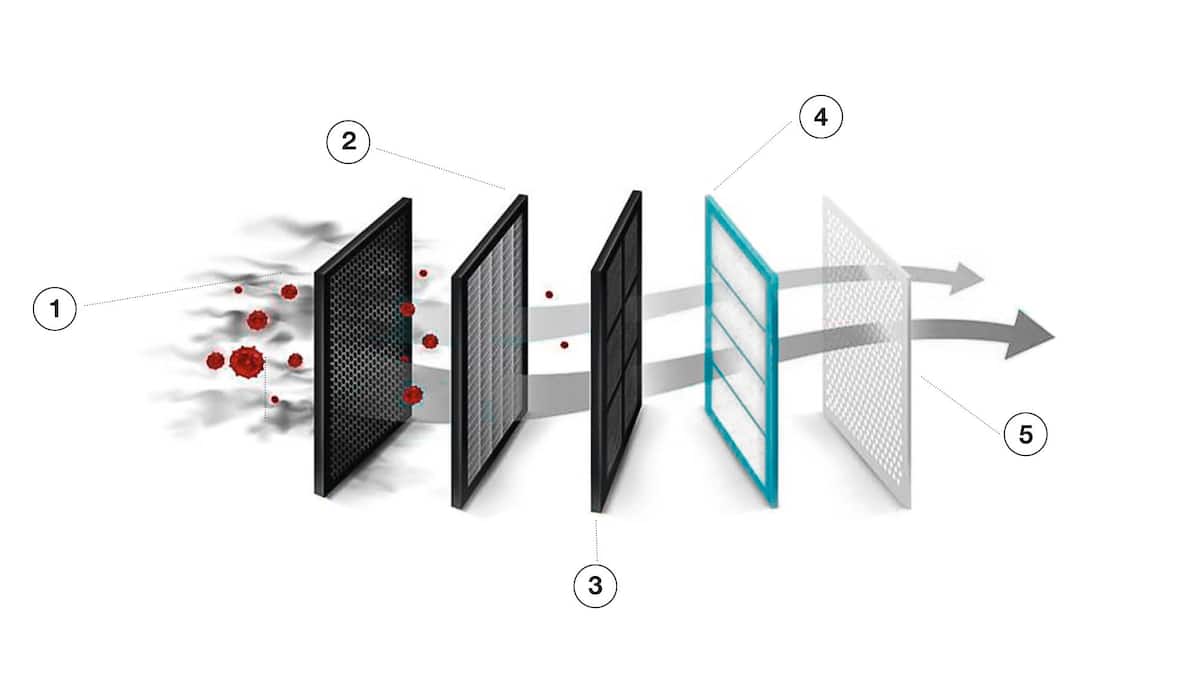
”"An interesting connection between our air purifier and the study from Switzerland (which you relate to above in the text) is that our air purifier has a built-in CO2 sensor and can be set to automatic operation so that the capacity is constantly adapted to the actual air purification needs in the room. This way you always get the lowest noise volume without compromising on the effect. This function is completely unique when it comes to professional air purifiers.
A choice of three different sizes of our air purifiers allows them to be adapted to rooms of up to 45, 80 and 200 m², and they can be combined as desired, depending on the area of application. With an air throughput capacity of up to 3000 m³ of air per hour (depending on model), all the air in a room can be moved and filtered six times per hour. A class G4 pre-filter and a fine filter retain larger airborne particles. In the subsequent stage, a high-performance HEPA particle filter H14 captures even the smallest particles, rendering more than 99.995 % of all airborne particles, viruses, bacteria and fungal spores inactive.
These models feature an automatic thermal deactivation of pathogens in the air flow, called Miele ThermoControl. Pathogens are defined as organisms that are capable of causing illness or infection in the body – viruses, bacteria, fungal spores and parasites are classified as pathogenic organisms. The air passing through the HEPA-14 filter in the air purifier is heated to around 70°C, which also prevents the formation of moisture. This innovative concept is complemented by an activated carbon filter. Unpleasant odours are therefore also a thing of the past.”
Subscribe to clean air
It is also possible to subscribe to clean air and Jacob Littorin says that many companies want to lease their air purifiers.
”"Although it is easy to change the filters on our air purifiers, anyone can do it, business users do not want to have to think about the service part. We believe that leasing together with service agreements, which include filter changes, will be a popular arrangement for our air purifiers and we have the advantage that we can offer nationwide service to all customers. It should be as easy as subscribing to your fruit basket for the coffee room," concludes Jacob.
Facts:
An adult takes about 20,000 breaths a day, which results in us exchanging around 12-15,000 liters of air a day! This can be compared to us drinking about 2 liters of water a day and eating 0.5–1 kg of food a day. We usually set high quality standards for both the liquid and the food, but do we set high enough standards for the air we breathe? One cubic meter of air can contain hundreds of thousands of particles.
Read more about the Miele range of air purifiers here.
Kent Oderud