

2022.03.30
Technology that tackles food waste
In the conference session Tackling Food Waste With Technology At CES 2022, Vonnie Estes, Vice President Innovation at the International Fresh Produce Association, spoke with Tim West, Spencer Martin, and Dr. Aidan Mouat about how technology can help reduce food waste, on the farm as well as in the store and home.
Dr. Aidan Mouat (third from left in the picture), Hazel Technologies Inc, introduced himself and his company by explaining that they sell products to prevent food waste, in the form of active packaging materials that after a certain time can release ingredients in the form of steam into the storage atmosphere of food products, so without having to add chemicals to the food and without having to change the packaging, you triple the shelf life.
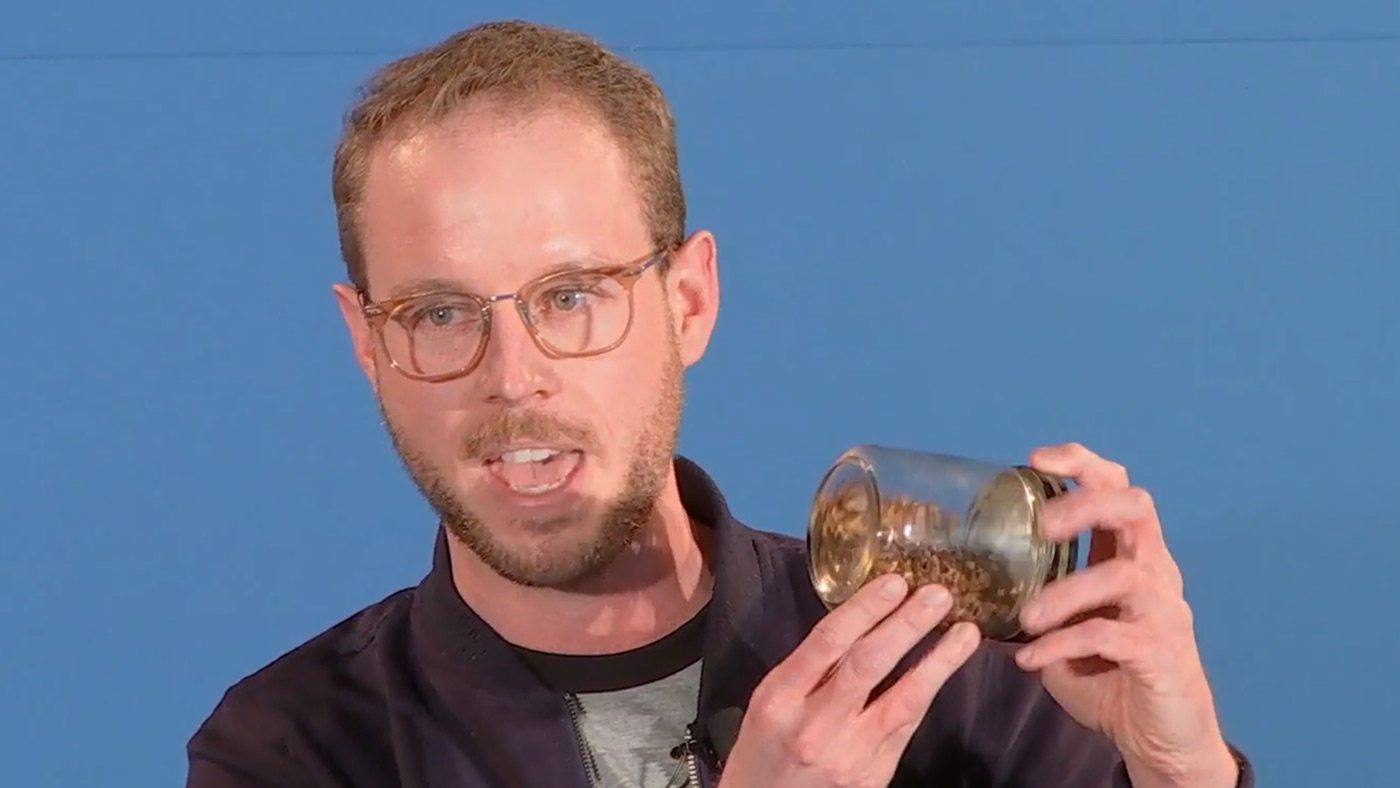
Spencer Martin (second from left), CEO and Cofounder at Clew, explained that they are making a household product – the size of a toaster – that in one to two hours grinds, heats and dries almost any type of food waste (including avocado pits, bones and coffee filters) into a precursor to compost that can regenerate soil.
Tim West (far left), President at True West Ventures LLC, is a Slow Food chef turned social entrepreneur. Tim founded True West Ventures, LLC as a consulting and experiential, educational design agency specializing in facilitating conversations about the future of food, food systems, food entrepreneurship, and food culture.
A third of all food is wasted
Tim West said that according to ReFED, a third of all food produced worldwide ends up in food waste. ReFED is a national, non-profit organization that works to stop food loss and waste in the American food system, and according to them, 35 percent of all food in the United States went unsold or uneaten in 2019, which corresponds to a value of just over $400 billion.
Tim further explained that fruits and vegetables account for 45 percent of food waste, while 99 percent of government subsidies in the US go to the production of corn, wheat, and soy (which are used to make processed foods) while only 1 percent goes to the production of specialty crops – which include fruits and vegetables.
”"Corn, wheat and soy lead to diabetes, heart disease and obesity. This is a whole other level of waste, which we are not even looking at," said Tim West.
”If food waste were a country, it would be No. 3 – after the US and China – in terms of carbon dioxide emissions, with food waste accounting for 8 percent globally. It is the single largest solvable emissions problem today,” he said. Dr. Aidan Mouat.
”Consumers are responsible for about 39 percent of food waste, and in the United States, $450-$1,300 worth of food ends up in the trash per person per year. It’s bad for both your wallet and the environment,” said Spencer Martin.
Production, delivery and plant breeding
When it comes to food production, problems sometimes arise when something happens in the global market, for example, which can lead to it suddenly becoming more expensive to harvest than the revenue would be if you harvest. But feeding the world today is not a problem in terms of production, it is rather a problem in terms of the supply chain.
An example of things that can be done that can help reduce risks is plant breeding using various technologies.
Vonnie Estes explained that broccoli grows so that it normally requires five harvests, and it is not uncommon for farms to skip the last two harvests – resulting in food waste. With plant breeding, it is possible to make it so that you only need to harvest twice.
One solution to how to significantly reduce global food waste is to decentralize production, that is, to localize it instead, which would reduce delivery problems – and things are starting to happen in this area, for example, stores starting to grow fruit and vegetables themselves, using various technical solutions for this.
Ola Larsson