
2022.02.16
Technology trends to watch
There are several global technology trends to monitor. In addition, a couple of elephants in the room that industry players are looking for solutions to. Hopefully the pandemic is over for now, but if a new global crisis comes, we will be better prepared. Here's the summary!
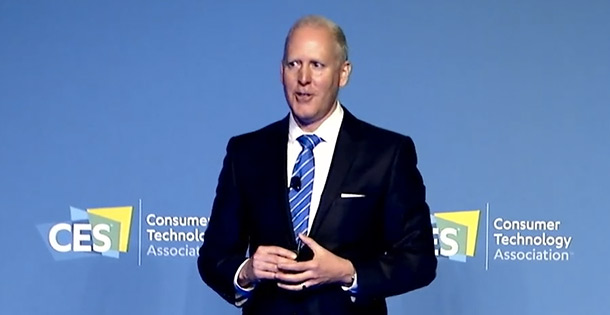
Smart home products in the U.S. grew 26 percent in value in 2021 compared to the previous year, when the increase was 19 percent compared to the year before. When it comes to smart home products, it is clear that consumers who buy one product often buy two or three more products, said Steve Koenig, Vice President of Market Research at Consumer Electronics Association, during his ”Trends to Watch” presentation at CES 2022, where he also explained that demand for technology remains strong.
Software & services are growing faster than hardware
Globally, sales of technology products increased by 30 percent in Q1 2021, by 22 percent in Q2 2021, and by 5 percent in Q3 2021, and the corresponding figures for Western Europe were 23, 24, and 4 percent. In the US, sales increased by 9.6 percent in value in 2021, with software/services accounting for about a quarter of sales while hardware accounted for three quarters. However, software/services grew slightly more than hardware – 11.4 percent and 9 percent, respectively – and this is a trend that is continuing, as the forecast for the current year is that software/services will increase by 6 percent while hardware is predicted to increase by 1.8 percent.
Premium products increase the most
Steve Koenig said that polarization is a trend we've seen for ten years, but it's now really taking off. In the first three quarters of 2021, premium brands in technology products grew by 40 percent globally, while standard brands grew by 10 percent. Looking at EMEA (Europe, Middle East and Africa), the trend is not quite as strong, as premium brands in this area grew by 27 percent and standard brands by 16 percent.

The elephants in the room
The two elephants in the room were also discussed. One was the development of freight prices during the pandemic, which have almost increased by a factor of ten. Before the pandemic, it cost about $2,000 to ship a 40-foot container, and last fall prices were closer to $20,000. Since then, prices have come down a bit, by about ten percent, but are still very high.
The other elephant in the room is the semiconductor shortage, illustrated by a picture of a large number of pickup trucks parked on a speedway track waiting for semiconductors. Steve Koenig said that the lead time for semiconductors has gone from just under two months to just over six months, which is obviously hitting many companies around the world hard. Steve said there are two solutions to this problem – one short-term and one long-term.
The short-term solution is to increase production in factories by introducing more shifts, so that the factories never stand still – if they ever do. That solution is a bit like shoveling sand against the tide…
The long-term solution is to build more semiconductor factories, and that is exactly what Intel, Samsung and others are doing. Intel is investing close to a hundred billion dollars in four new factories (two in the US and two in Europe) and Samsung is investing even more (including a new factory in the US) with the ambition of becoming a leader in semiconductor production. However, a semiconductor factory is not something you can build on a coffee break, but it takes two to three years from start to finish. Today, three out of four semiconductors are built in East Asia, and one idea behind these ongoing investments is to change that situation, to reduce vulnerability to a variety of future scenarios…
5G & AI
Finally, it was mentioned that at the beginning of Q2 this year, a number of standard protocols for 5G will be finalized by 3GPP (3rd Generation Partnership Project, a collaborative organization in telecommunications), which published the first versions of the 5G standard back in 2018. This is expected to be the starting point for industrial IoT applications. 5G is the first wireless standard that is, so to speak, led by companies and not consumers.
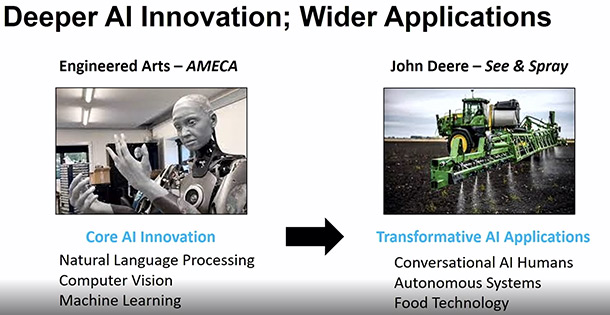
Hand in hand with 5G, you could say that AI goes, and in this area, transformative AI applications were exemplified with John Deere's "See & Spray", which means that AI is used to find weeds and spray them, instead of spraying the entire field. Better for the environment and good for the farmer.
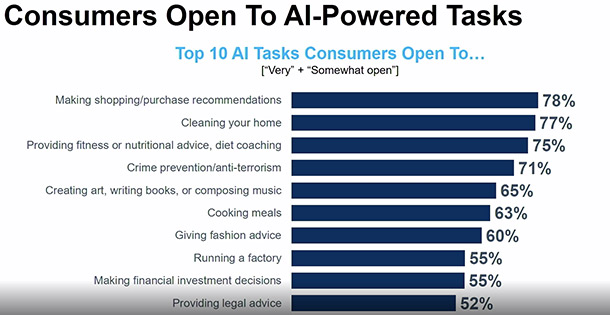
In a survey last December (CTA Artificial Intelligence: Consumer Sentiment 2021) took Consumer Technology Association find out what consumers are willing to let AI do for them. In second place (with 77 percent of respondents positive) was ”cleaning the home” and in sixth place (with 63 percent of respondents positive) was ”cooking”.
Ola Larsson